

Cultural History / Historical Metrology / October 2026
A rigorous inquiry into an old joke, a vanished retail unit, and the limits of arithmetic.
Research White Paper · Dan Peters Designs · October 18, 2026
Download the White Paper (PDF)
ABSTRACT
The question “How many joints are in a lid?” sounds numerical, but the historically relevant units are not fixed. “Lid” referred to a customary quantity of marijuana in the United States during the 1960s and 1970s, yet surviving evidence documents multiple conventions. Some sources described approximately 22 grams; others described approximately one ounce. Reports of the number of cigarettes that could be made from a lid likewise varied. This paper evaluates period journalism, a judicial record, government-era reporting, dictionaries, and retrospective testimony. It finds that the question is underdetermined: a meaningful count requires both the size and usable content of a “lid” and a specified amount per joint. Its most famous comic answer—two—illustrates the logical problem rather than resolving it.
The question has no unique numerical answer without definitions that the joke deliberately withholds. Contemporary sources support customary answers around 40–50 under some assumptions; comedy supports two under another.
01 THE QUESTION IS OLDER THAN THE ANSWER
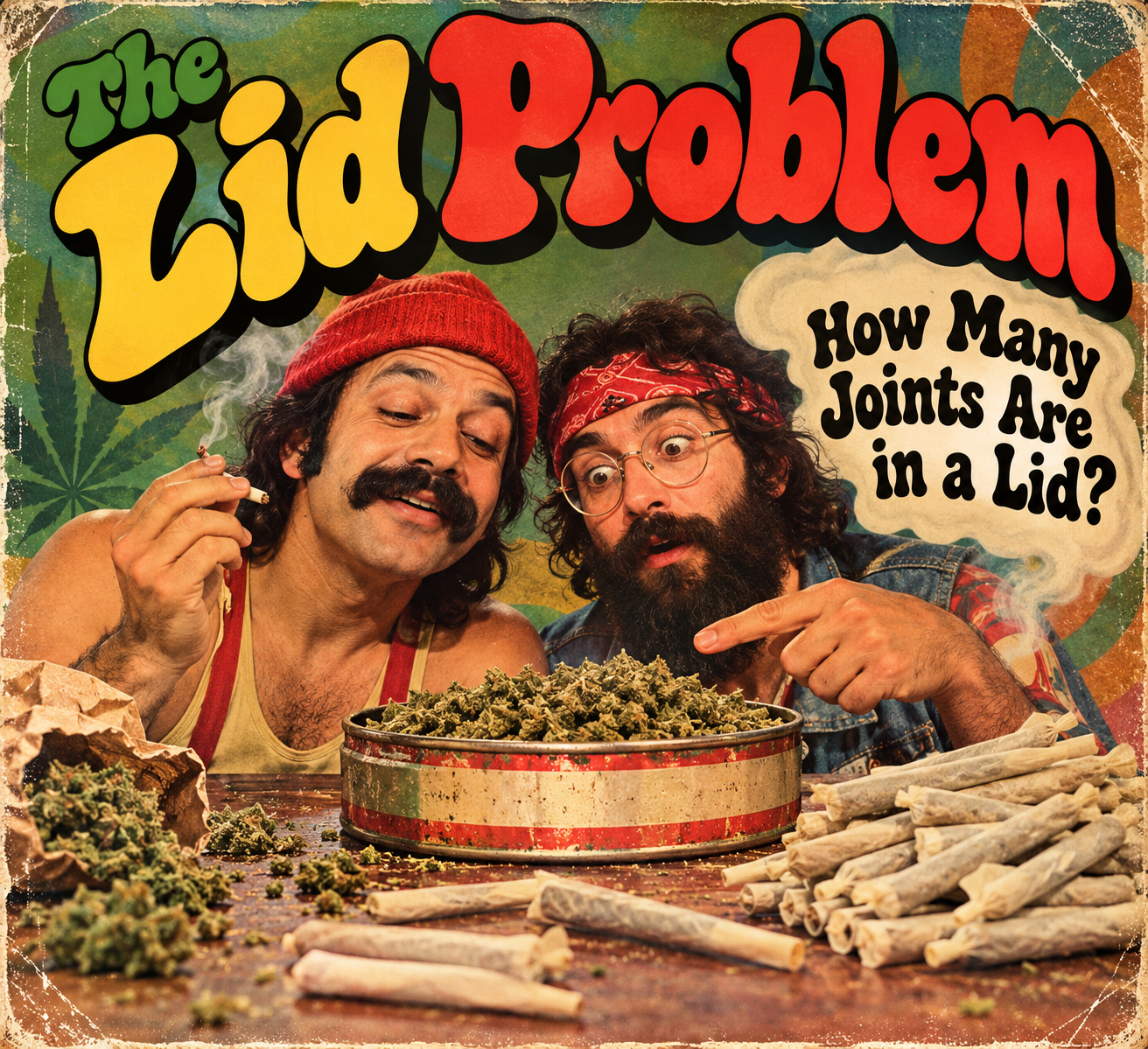
The line is remembered from Cheech & Chong’s “Let’s Make a Dope Deal,” a sketch on the 1972 album Big Bambu. Asked how many joints are in a lid, the contestant answers “Two,” and explains that he rolls unusually large joints. The judges accept the answer. It works because the exchange exposes a missing premise: neither the source quantity nor the size of the resulting unit has been established. [9–10]
Instead of treating the line as nonsense, we can frame it as a legitimate measurement problem. What was a lid? Was it a defined mass, a containerful, a bag of a specified apparent size, or merely the conventional amount exchanged at a given price? And, independently, what was a “joint” supposed to contain?
02 THE MEANING OF “LID”
The term is not an acronym. It is an ordinary English noun given a specialized slang sense. Modern dictionaries summarize that sense as an ounce, or usually an ounce, of marijuana. Those definitions are useful guides to conventional meaning, but they do not certify the exact contents of each historical purchase. [6–7]
A more careful taxonomy distinguishes four possible meanings: (1) a nominal mass, approximately one ounce; (2) a customary retail portion that could be “short” or “long”; (3) a volume or visually estimated bagful; and (4) a price-associated unit. These meanings can overlap in practice without being mathematically identical. One ounce is a mass. A container lid is a piece of hardware. Four fingers is a variable width. Ten dollars is a price. None converts to the others without additional assumptions.
The origin story remains unproven
Several retrospective accounts link the word to using a coffee-can lid, tobacco tin, mason-jar lid, or a finger-depth of marijuana in a sandwich bag as a rough measure. These recollections are historically interesting, but they conflict, and a repeated explanation is not an established first use. Etymonline cautiously says a jar lid was “presumably” involved. The precise container, location, and transition from physical lid to retail noun have not been demonstrated by the sources reviewed here. [7–8]
03 WHAT CONTEMPORARY RECORDS ACTUALLY SAY
Period evidence is more revealing than a present-day dictionary because it records competing conventions while the term was in circulation. Five especially relevant observations appear in the available record:
| Date | Record | Reported measure / count | Significance |
|---|---|---|---|
| Mar 1967 | TIME, “Love on Haight” | A lid identified as 22 grams; price $10 in San Francisco. | A period-specific quantity below the modern ounce definition. [1] |
| 1967 sale; 1969 case | People v. Dickerson | Three lids sold for $30; each reported at approximately 21.92 grams. | An independently documented transaction close to 22 grams. [2] |
| Sep 1967 | TIME, “Dream Farm” | A commercial lid said to yield about 40 cigarettes. | An historical yield claim, not a verified standard roll. [3] |
| Autumn 1969 | Operation Intercept reporting | A lid described as “about one ounce” and sufficient for 45–50 joints. | Different nominal mass and estimated yield; pricing had risen. [4] |
| Sep 1971 | Congressional Record | San Francisco charging practice mentioned a lid as “about one ounce.” | Shows that the ounce convention also circulated in official discourse. [5] |
Exhibit 1. The figures above were reported in differing contexts, not measured under a common protocol. They must not be averaged into an invented universal standard.
The 1967 period account and the reported weight in the California case are unusually close: 22.00 versus 21.92 grams. Their agreement makes the 22-gram convention difficult to dismiss as mere misremembering. On the other hand, “about one ounce” is also attested in sources contemporary with the counterculture. The two conventions differ by roughly 29% in nominal mass, before any allowance for stems, seeds, packing, or preparation. [1–2, 4–5]
Price is similarly unstable. A 1967 San Francisco report described a $10 lid; 1969 reporting describes $14–$15 after a period of supply disruption. A market may retain a familiar label even while prices, quantities, or quality change. The historical evidence therefore supports the existence of a customary transaction, not a universal standard verified by calibration. [1, 4]
04 WHY THE COUNT CANNOT BE CALCULATED DIRECTLY
The problem contains at least three unknowns: the gross material included in the lid; the fraction of that material actually usable for the object being counted; and the amount included in each joint. The simplest model is:
L = purchased mass | f = usable fraction | j = mass per joint | N = complete joints
The equation is deliberately elementary. Its significance is not computational difficulty but the absence of inputs. If we assume that L = 22 grams, all 22 grams are usable, and each joint contains 0.55 gram, then N = 40. That scenario resembles the 1967 press estimate. If instead L = 28.35 grams under the same assumptions, N = 51 complete joints. Both are arithmetic consequences of declared assumptions, not historical measurements of a typical joint. [1, 3–4]
To obtain two, set j equal to half the usable contents of the lid. Nothing in the original question prohibits doing so. The comic answer is therefore formally admissible. Its improbability is social, not mathematical: the speaker has supplied a strikingly unconventional joint size after the fact.
What the word “joint” hides
The number of rolled cigarettes is not inherently a standardized yield measure. Size, packing density, inclusion of tobacco or other material, rolling losses, and the removal of seeds or stems can all affect the count. A source that says “40 cigarettes” provides evidence that people used that estimate; it does not establish a reproducible conversion factor for all sellers and all buyers.
05 A SOURCE-CRITICAL READING OF THE FOLKLORE
We can rank the evidence without pretending to have laboratory precision. A court opinion reporting the mass of an identified purchase is strong evidence for that purchase; it cannot define the national retail unit. Contemporary journalism documents what reporters were told at the time but may simplify street practices. Government statements reveal institutional terminology, not necessarily trade uniformity. Dictionaries record consolidated meanings, often after a word has stabilized or faded. Decades-later oral recollections preserve lived vocabulary and its regional texture while inviting memory distortion. [1–8]
This hierarchy matters especially for the origin question. That several people remember cans or tins makes the proposed explanation plausible. It does not prove which physical lid came first, nor whether the commercial unit evolved from a measured container, from a package convention, or from several unrelated local practices that eventually merged into one name. The available record does not settle that etymology.
It is equally important not to confuse an attestation with an invention. The fact that the slang use appears in printed sources by 1967 establishes that it was in circulation by then. It does not establish the day, place, or person who coined it. [1, 3, 7]
06 CONCLUSION: AN ANSWER IN SEARCH OF A DEFINITION
If the question means “How many fairly ordinary joints might one commonly have expected from a lid in the late 1960s?”, the contemporary record contains estimates of about 40 and 45–50. If the question instead demands an exact and universal number, the evidence supplies no such answer. “Lid” had more than one operative meaning, and “joint” offered no fixed denominator. [3–4]
Cheech & Chong’s answer of two works because the rules of the question never excluded it. The joke is a compact lesson in dimensional analysis: to divide one quantity by another, the quantities must first be defined. In this case the cultural meaning survived far better than the measurement protocol.
Historically: approximately 40–50 in certain contemporary accounts. Mathematically: indeterminate without further assumptions. Comedically: two.
REFERENCES / SOURCE NOTES
- TIME (17 March 1967). “San Francisco: Love on Haight.” Contemporary 22-gram usage and retail price. Source ↗
- People v. Dickerson, 270 Cal. App. 2d 352 (Cal. Ct. App. 1969). Court record of 1967 purchases described as approximately 21.92 grams per lid. Source ↗
- TIME (8 September 1967). “Hippies: Dream Farm.” Period estimate of about 40 cigarettes per lid. Source ↗
- Lawrence A. Gooberman. Operation Intercept: The Multiple Consequences of Public Policy, ch. 1. Reproduces 1969 U.S. Customs estimates and October 1969 press reporting. Source ↗
- Congressional Record—Senate (22 September 1971), discussion of San Francisco marijuana charging practice; “lid” described as about one ounce. Source ↗
- American Heritage Dictionary of the English Language. Entry “lid.” Modern dictionary definition of the slang sense. Source ↗
- Online Etymology Dictionary. Entry “lid.” Dates marijuana sense to 1967; physical-lid derivation marked as presumptive. Source ↗
- 420 Magazine (2006 onward). “What’s a lid?” Online reminiscences offering conflicting bag, tin, finger, and weight explanations; used as oral history, not verified origin proof. Source ↗
- Cheech & Chong, “Let’s Make a Dope Deal,” Big Bambu (Warner Records, 1972). Recording and album attribution. Source ↗
- Goldmine. “Cheech and Chong presented their own green new deal in the 1970s.” Album and sketch historical discussion. Source ↗
METHOD NOTE Sources are identified by date and provenance. Reported weights, observed transactions, journalistic estimates, and post-hoc memories are not pooled as if they represented the same measured population. The model in Section 04 is illustrative, not an estimate of actual historical rolling behavior.