

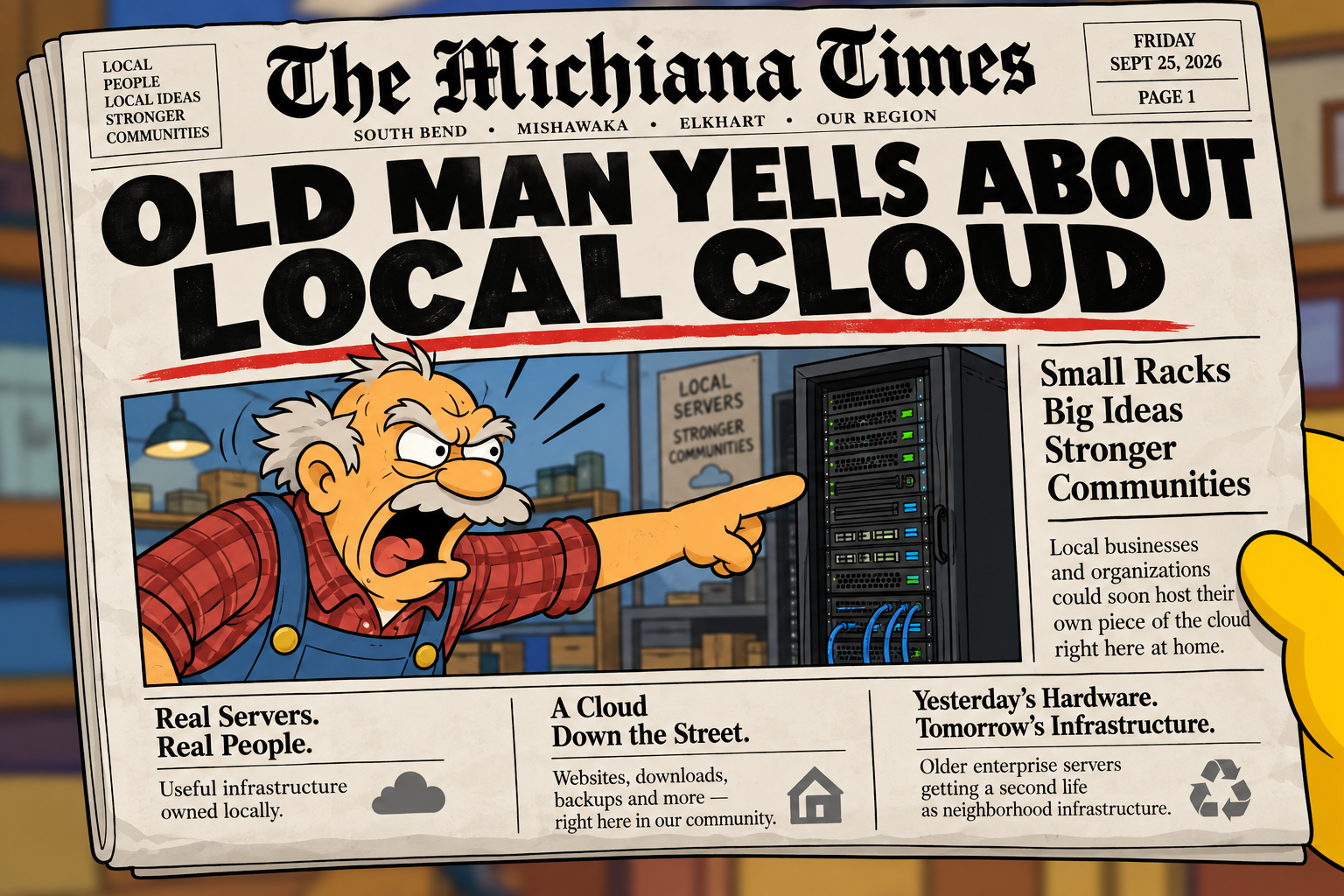
A few weeks ago, I wrote about an idea I had been working toward: what if locally owned servers could become useful community infrastructure?
That idea started with A Community Cloud Built From Local Racks, where I sketched out what a distributed network of locally hosted server stacks might look like.
Not one giant data center. Not another subscription service. Not somebody else’s cloud on the other side of the country.
Small racks of real servers, placed in local businesses and organizations, doing useful work for the people around them.
At the time, I called it a community cloud built from local racks.
Well, the first rack is ready.
From an Idea to a Stack of Servers
The idea behind the Amadi Mirror Stack is deliberately pretty simple.
Instead of asking one giant machine to do everything, the work is divided between three small server-class computers.
One is the Control server. It manages the rack, monitors the other machines, handles recovery and maintenance, and can even turn the other servers on and off remotely.
One is the Web server. That’s the public-facing machine—the one that can host websites, WordPress installations, project pages, downloads and other web services.
And one is the Database/Mirror server. It takes care of databases, backups, mirrors, archives and the larger collections that don’t need to live directly on the public web server.
A managed network switch ties everything together while keeping the servers’ hardware-management network separated from their normal traffic.
That’s the stack.
No magic. No mysterious “cloud technology.”
Just computers with clearly defined jobs, set up so they can work together and be repaired, replaced and duplicated without rebuilding the whole system from scratch.
Why Call It a Cloud?
Because “the cloud” has never actually been a cloud.
It’s computers.
Usually they’re computers owned by enormous companies, sitting in enormous data centers, and we rent little pieces of them.
There’s nothing inherently wrong with that. Those systems are incredibly useful.
But they aren’t the only way computers can provide shared infrastructure.
What we’ve built is much smaller.
And that’s exactly the point.
A local rack can host websites. It can hold downloads. It can maintain mirrors and backups. It can store databases and archives. It can provide resources to projects, artists, organizations and small businesses.
Put another rack somewhere else, and those locations can begin backing up and mirroring important resources between them.
Put several in different places, and something interesting starts to happen.
You don’t have one giant computer.
You have infrastructure.
The First Mirror Stack
We’ve now finished the first Amadi Mirror Stack intended to become one of those off-site nodes.
Its three machines are configured.
The network is configured.
The separate hardware-management network is working.
The Control server can reach the management controllers in the other machines and remotely power them on.
The servers are being standardized to recover automatically after power loss and boot unattended instead of waiting for somebody to stand in front of them and press a key.
That’s a small detail until the server is ten miles away.
Then it’s a very important detail.
The rack has been designed around the assumption that most of the time nobody will be standing next to it.
That’s the difference between assembling some old computers and building infrastructure.
Yesterday’s Servers, Tomorrow’s Infrastructure
There’s another part of this project that I particularly like.
These aren’t exotic new machines.
Much of the Amadi hardware is older enterprise equipment—the kind of hardware businesses eventually replace because their needs have moved on.
But “not new enough for a corporate data center” and “not useful anymore” are two very different things.
A server doesn’t need to be the fastest machine on Earth to host a local artist’s website.
It doesn’t need the newest processor available to hold an archive.
It doesn’t need to consume half a rack and a five-figure budget to maintain a mirror of useful files.
Give older server hardware a sensible job, and there’s an enormous amount of useful life left in it.
That’s part of what this experiment is about too.
Use what we have. Understand it. Repair it. Give it a job.
What Could Local Clouds Actually Do?
This is where the project gets interesting.
Imagine a few of these racks spread around a community.
One might live at a small business. Another at a makerspace. Another at an arts organization, nonprofit or community facility.
They don’t all have to do exactly the same thing.
They can host websites for local projects and organizations.
They can provide download mirrors so useful material isn’t dependent on one machine or one location.
They can maintain copies of archives and community resources.
They can hold educational material and project repositories.
They can back up selected resources between locations.
If one location has a problem, another doesn’t suddenly cease to exist.
And because the machines are physically local, the infrastructure belongs to actual people and organizations in the community rather than existing as an abstract monthly bill from a distant provider.
That’s the larger experiment.
Not replacing Amazon.
Not building the next giant cloud company.
Building something smaller on purpose.
The Cloud Can Be Down the Street
We’ve become accustomed to thinking about Internet infrastructure as something that has to happen somewhere else.
Some enormous building in Virginia.
Some warehouse full of machines in another state.
Some service operated by a company most of us will never have any relationship with beyond a login and a credit card.
But some infrastructure can be local.
Some of it can be owned locally.
Some of it can be repaired locally.
And some of it can serve a community without first becoming a billion-dollar technology company.
That’s what I want to find out with Amadi.
How much useful infrastructure can we build from inexpensive hardware, open software, sensible design and cooperation between people who are willing to host a little piece of it?
We finally have something that can start answering that question.
Now We Need Somewhere to Put It
The first mirror stack is ready for its next step.
It needs a box and a home.
The box is straightforward: a small rack enclosure suitable for the servers and network equipment.
The home is more interesting.
I’m looking for a local business, makerspace, arts organization, nonprofit, community organization or similar place interested in hosting the first off-site Amadi Mirror Stack.
It doesn’t require a data center.
It needs a secure place for a small server rack, electrical power, and a reliable Internet connection.
I’ll take care of the servers.
I’ll take care of the software.
I’ll take care of administration and maintenance.
The host provides a little space, power and connectivity.
And together we get to try something I’ve wanted to see for a long time:
a piece of the cloud that actually lives in our community.
The first one is built.
Now let’s give it an address.