

Introduction
Americans are taught from childhood that nobody is above the law.
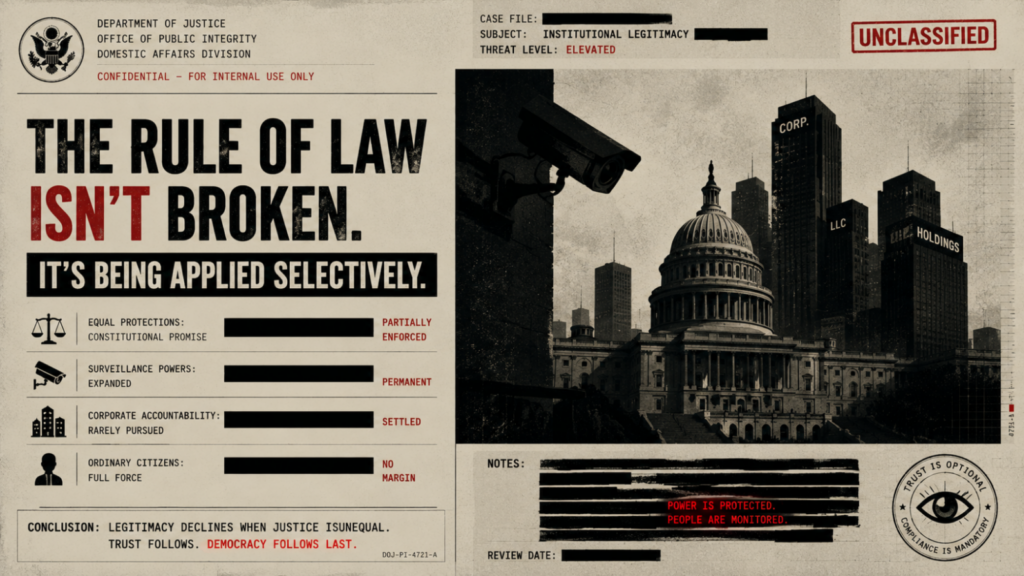
That idea sits at the center of the American identity. The Constitution, the courts, the separation of powers, due process, civil liberties — all of it is supposed to serve as a safeguard against arbitrary power. The government is meant to answer to the law, not stand above it.
But over the last twenty years, more and more Americans have started asking a question that once would have sounded extreme:
What happens if the rule of law still exists on paper, but no longer functions equally in practice?
This question is no longer confined to political radicals or conspiracy circles. Distrust in institutions has spread across nearly every demographic and political category in the country. Many Americans now believe that legal accountability depends heavily on wealth, political influence, media protection, or institutional connections.
For some people, the breaking point was the 2008 financial collapse. For others, it was the expansion of surveillance after 9/11, the politicization of federal agencies, inconsistent criminal enforcement, or the growing perception that large corporations can violate laws with minimal consequences.
The issue is not simply corruption. Corruption has always existed.
The deeper concern is whether the American system still applies law consistently enough for citizens to trust it.
A society does not lose faith in the rule of law overnight. It erodes slowly. People begin assuming outcomes are predetermined. They stop believing institutions are neutral. They lose confidence that the system protects ordinary citizens equally.
Once that happens, democracy itself starts becoming unstable.
What the Rule of Law Actually Means
The phrase “rule of law” sounds abstract, but the idea is fairly simple. It means laws are supposed to apply equally to everyone. Not just to ordinary citizens.
To politicians.
To corporations.
To police.
To federal agencies.
To the wealthy.
To people with influence.
Under a functioning rule-of-law system, laws are publicly known, courts operate independently, citizens possess due process rights, governments remain constrained by constitutional limits, and enforcement is expected to operate consistently rather than selectively or politically.
The Founders understood how dangerous concentrated power could become. That is why the American system was intentionally fragmented between branches of government. The structure was designed to prevent any single institution from becoming dominant.
At least in theory.
The modern concern is not that these systems no longer exist. They clearly do. The concern is that many Americans no longer believe those systems are functioning impartially. That loss of trust matters more than many institutions seem willing to admit.
The Collapse of Public Trust
Public trust in American institutions has been deteriorating for decades. Confidence in Congress is historically low. Trust in major media organizations has collapsed. Faith in federal agencies, corporations, universities, and even the Supreme Court has declined sharply. That does not automatically mean the rule of law is dead. But it does suggest that millions of Americans no longer believe the system operates fairly. That distinction matters.
A legal system ultimately depends on legitimacy. Governments can enforce laws through force for a while, but democratic societies rely heavily on voluntary public acceptance of institutional authority. Once enough people begin seeing institutions as politically captured or selectively enforced, every legal action starts looking partisan. At that point, even legitimate rulings become suspect. You can already see this dynamic playing out across the country.
People increasingly assume investigations are politically motivated, media narratives are manipulated, wealthy actors will avoid meaningful accountability, and institutions ultimately protect insiders first. Whether every one of those assumptions is correct is almost secondary. The damage comes from the fact that so many people believe them.
Unequal Accountability
One of the strongest arguments against the current system is that accountability often appears deeply unequal. Ordinary people can lose their jobs, homes, savings, reputations, or freedom over relatively small violations. Meanwhile, powerful institutions often absorb legal penalties as operational costs.
The 2008 financial crisis remains one of the clearest examples.
Millions of Americans lost homes, retirement savings, and financial stability. Entire communities were devastated. Yet relatively few high-level executives faced criminal prosecution.
For many Americans, that moment permanently changed how they viewed the system. It created the impression that there are effectively two legal standards operating in the United States: one for ordinary citizens and another for institutions considered too powerful, too connected, or too economically important to seriously punish.
That perception has only intensified over time. Corporate settlements regularly involve enormous misconduct paired with limited individual accountability. Political figures from both parties are accused of receiving preferential treatment. Wealthy defendants often possess legal resources that ordinary citizens could never access. None of this proves that the rule of law is completely gone. But it does raise a dangerous question: If enforcement consistently appears unequal, how long before the public stops believing equality under law exists at all?
Expanding Government and Administrative Power
Another major concern is the growth of executive and bureaucratic authority. Over time, both Republican and Democratic administrations have expanded the use of executive orders, emergency powers, federal surveillance programs, and administrative agencies.
Congress increasingly appears unable — or unwilling — to exercise meaningful restraint over the executive branch. As a result, enormous influence now sits inside permanent bureaucratic structures that most citizens neither voted for nor directly control. Supporters argue this is necessary in a modern society. The federal government manages an incredibly complex nation and requires specialized agencies to function.
Critics argue something else entirely.
They believe unelected institutions now wield enormous influence over speech, commerce, labor policy, public health decisions, digital communication systems, banking structures, and the flow of information itself.
The concern is not simply size. It is opacity.
Many Americans feel decisions affecting their lives are increasingly made inside systems they cannot meaningfully influence, challenge, or even fully understand. That feeling creates political alienation very quickly.
Information Control and Media Fragmentation
The internet was supposed to democratize information. In some ways, it did. In other ways, it shattered the shared reality democratic societies depend on. Americans now live inside radically different media ecosystems. Algorithms push outrage because outrage drives engagement. Political media profits from division. Social platforms reward emotional reaction more than accuracy. The result is a population that increasingly cannot agree on basic facts.
At the same time, concerns about censorship, coordinated moderation, state influence over digital platforms, and information suppression have intensified distrust. Some critics believe major technology companies possess levels of narrative control that would have been unimaginable twenty years ago. Others argue that misinformation has become so widespread that stronger moderation is necessary. Either way, the outcome is the same: Americans increasingly distrust both mainstream institutions and alternative sources simultaneously. That is a dangerous place for a democracy to exist. Because the rule of law depends partly on shared legitimacy.
A society that cannot agree on reality eventually struggles to agree on justice.
Surveillance and the Normalization of Monitoring
The expansion of surveillance after 9/11 changed the relationship between citizens, corporations, and the state. Mass data collection, location tracking, predictive algorithms, facial recognition systems, and digital monitoring have become normalized parts of modern life.
Most Americans interact daily with systems capable of collecting extraordinary amounts of behavioral information. Governments are not the only concern. Private corporations now possess massive amounts of personal data, often exceeding what governments historically could access. Many people accepted these systems gradually because they arrived through convenience. Smartphones, social media platforms, digital payment systems, cloud services, location-based apps, and algorithmic recommendation engines became deeply embedded in everyday life. But convenience can quietly reshape expectations about privacy and civil liberties.
Civil liberties advocates have warned for years that surveillance systems rarely shrink once established. The long-term concern is not merely privacy. It is power. A society where institutions possess near-total visibility into citizens while remaining increasingly opaque themselves creates an imbalance that many Americans find deeply unsettling.
Political Polarization and Institutional Weaponization
Political polarization has accelerated nearly every institutional problem in the country. Americans no longer simply disagree on policy. Many increasingly view opposing political factions as existential threats. That mindset changes how legal institutions are perceived.
Every investigation becomes political.
Every prosecution becomes ideological.
Every court ruling becomes tribal.
When this happens consistently, law stops feeling neutral. It starts feeling like a tool used by whichever faction currently possesses institutional power. This perception is extraordinarily dangerous. Because once citizens stop believing disputes can be resolved fairly through institutions, they begin searching for other forms of power. History shows that democratic systems rarely collapse all at once. More often, they deteriorate through escalating distrust, institutional paralysis, selective enforcement, and mutual political dehumanization. The United States is not immune to those pressures simply because it has a Constitution.
Is the Rule of Law Actually Dead?
Despite all of these concerns, declaring the rule of law completely dead would still be an overstatement.
Courts still issue rulings against government actors. Investigative journalists continue exposing corruption. Whistleblowers still emerge, elections still occur, and civil rights organizations continue challenging abuses of power through the legal system.
Those things matter. The United States is clearly not operating as a fully authoritarian state. But there is another possibility that may be more accurate. The country may be entering a period where democratic institutions still formally exist, while public confidence in those institutions steadily collapses.
That distinction is important. A constitutional system can survive technical crises. What it cannot survive indefinitely is mass loss of legitimacy. Once enough citizens conclude that justice is selective, accountability is performative, and institutions primarily protect themselves, the social contract begins breaking apart.
That process may already be underway.
Conclusion
The argument that the rule of law is dying in the United States is ultimately an argument about trust.
Not trust in perfection.
Nobody seriously believes American institutions have ever been flawless.
The issue is whether citizens still believe the system fundamentally attempts to apply laws fairly and consistently.
For growing numbers of Americans, the answer appears to be no.
That distrust is fueled by unequal accountability, institutional opacity, political polarization, surveillance expansion, corporate influence, and declining confidence in nearly every major public institution.
Whether those concerns represent temporary instability or long-term democratic decline remains uncertain.
But history suggests that once institutional legitimacy begins eroding, rebuilding it becomes extremely difficult.
The rule of law does not disappear in a single dramatic moment.
It fades when enough people stop believing it exists.
References
Dicey, A.V. Introduction to the Study of the Law of the Constitution. Macmillan, 1885.
Fukuyama, Francis. Political Order and Political Decay. Farrar, Straus and Giroux, 2014.
Levitsky, Steven, and Daniel Ziblatt. How Democracies Die. Crown Publishing, 2018.
Snyder, Timothy. On Tyranny: Twenty Lessons from the Twentieth Century. Tim Duggan Books, 2017.
Arendt, Hannah. The Origins of Totalitarianism. Harcourt, 1951.
Pew Research Center. “Public Trust in Government: 1958–2024.”
Gallup. “Confidence in Institutions.” Annual polling series.
American Civil Liberties Union. Reports on surveillance, privacy, and civil liberties.
United States Supreme Court opinions relating to executive authority, due process, and constitutional limits.