

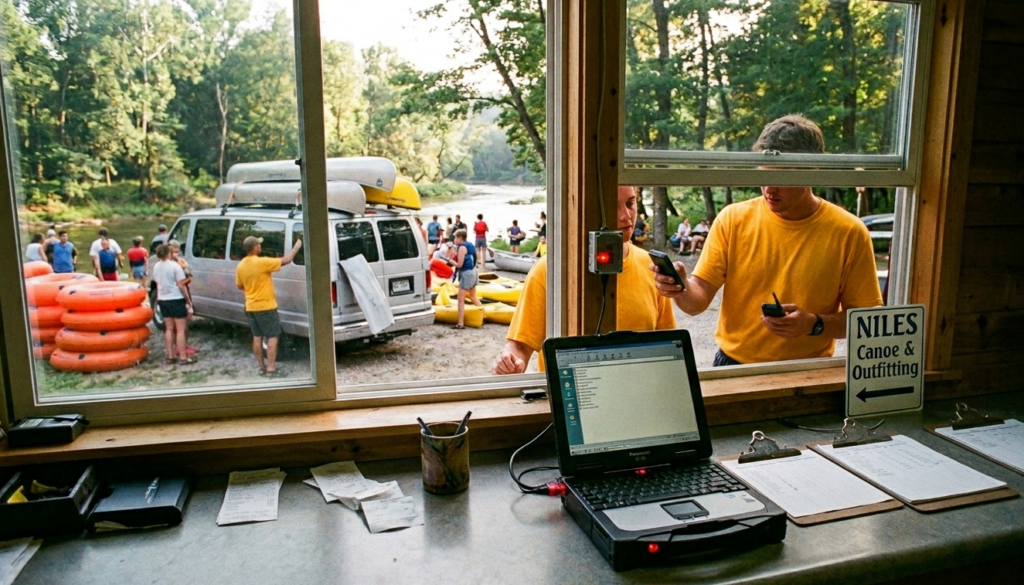
Long before the modern cloud was a utility, Dan Peters Designs was solving high-stakes logistical problems with salvaged hardware and infrared data. This was the spiritual “Beta Test” for the sovereign home node—built out of necessity on the banks of the Dowagiac River.
The Logistical Gap
Managing 200 guests across 28 miles of wild, protected river with six staff members and two 15-passenger vans was a massive data problem. In the heyday of the Nokia “brick” phone, there was no real-time coordination. You had voice calls, but no way to track the complex, moving parts of a multi-group river tour.
The Salvaged Mesh
Instead of waiting for technology to catch up, DPd built a custom logistical network using the “Rugged & Reliable” philosophy:
- The Hardware: Two salvaged Panasonic Toughbook CF-25s (purchased at a police auction) and half a dozen of Palm Pilots.
- The Interface: Leveraging the Infrared (IR) data transfer capabilities that were standard on PDAs and early Toughbooks.
- The Relay: I engineered a system where IR transmitters acted as data nodes. When the vans parked to pick up boats or passengers, they would automatically sync data with the main office computers via IR.
Real-Time Sovereignty
Every staff member carried a Palm Pilot. With a quick IR sync, they had a localized dashboard that outperformed anything available to the general public at the time:
- Guest Tracking: Visibility into the location of every guest, staff member, and vehicle in our realm.
- Smart Scheduling: Task lists linked to reminder alarms and the daily schedule, ensuring no boat or passenger was ever left behind.
- Operational Flow: The desk and the field were always in sync, without needing a single cell tower or external “cloud” provider.
The Full Circle
This era proved that you don’t need “Big Tech” to run a complex operation—you need rugged hardware and an intimate understanding of the mechanics. It’s no coincidence that the current “Omni-Deck” project is being built into a CF-25 chassis. The tools have evolved, but the DPd requirement for a rugged, independent, and functional system remains exactly the same.
The river eventually went quiet, but the logic survived. After a long hiatus, the workbench is back—read about the current [Sovereign Stack & Home Server Node] era here.”
[…] Niles Canoe and Outfitting The era culminated in the acquisition of Niles Canoe and Outfitting from a close friend. This wasn’t just a business move; it was a total immersion into river management. Serving as the manager, instructor, and ranger for 28 miles of wild, protected river, the work involved: […]