

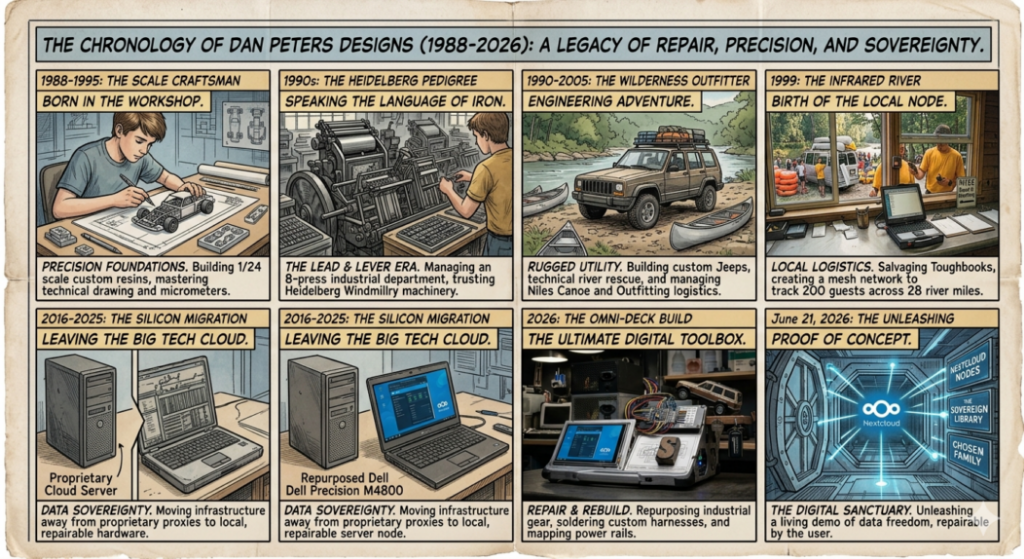
The common thread running through Dan Peters Designs—from the first 1/24 scale resin part in 1988 to the current server migration—is a refusal to accept “disposable” as a standard.
Whether it was a 100-year-old letterpress, a 1980s Jeep, or a 2016 Dell workstation, the DPd philosophy is built on three pillars:
1. The Utility of Salvage We don’t buy “new” just because it’s shiny. We find industrial-grade hardware that has been discarded and rebuild it to outperform modern, locked-down alternatives. This is why I repurpose Panasonic Toughbook chassis into “Omni-Decks” and map 12V rails on salvaged server power supplies. If you didn’t build it (or at least repair it), you don’t truly own it.
2. Mechanical Intimacy Running 8 presses, 2 being Heidelberg windmills, at 26 years old taught a vital lesson: you have to “speak” the language of your machines. Today, that translates to the command line. I don’t use “black box” cloud services. I use Linux Mint, Docker, and Nextcloud because they allow me to see the gears turning. Managing my own local server environment and databases is the modern equivalent of owning my own printing press.
3. Infrastructure for the Chosen Family Just as the Outfitter era was about providing gear for those who needed it, the current Home Node project is about providing a digital sanctuary. By building an independent, offline-capable environment, I’m creating a “Digital Jeep”—a rugged, turnkey system for my chosen family that doesn’t rely on the permission or prying eyes of Big Tech.
Precision is eternal. Whether it’s measured in micrometers on a model car or in latency on a local node, the standard remains: Build it right, make it repairable, and keep the keys.
[…] quiet, but the logic survived. After a long hiatus, the workbench is back—read about the current [Sovereign Stack & Home Server Node] era […]