

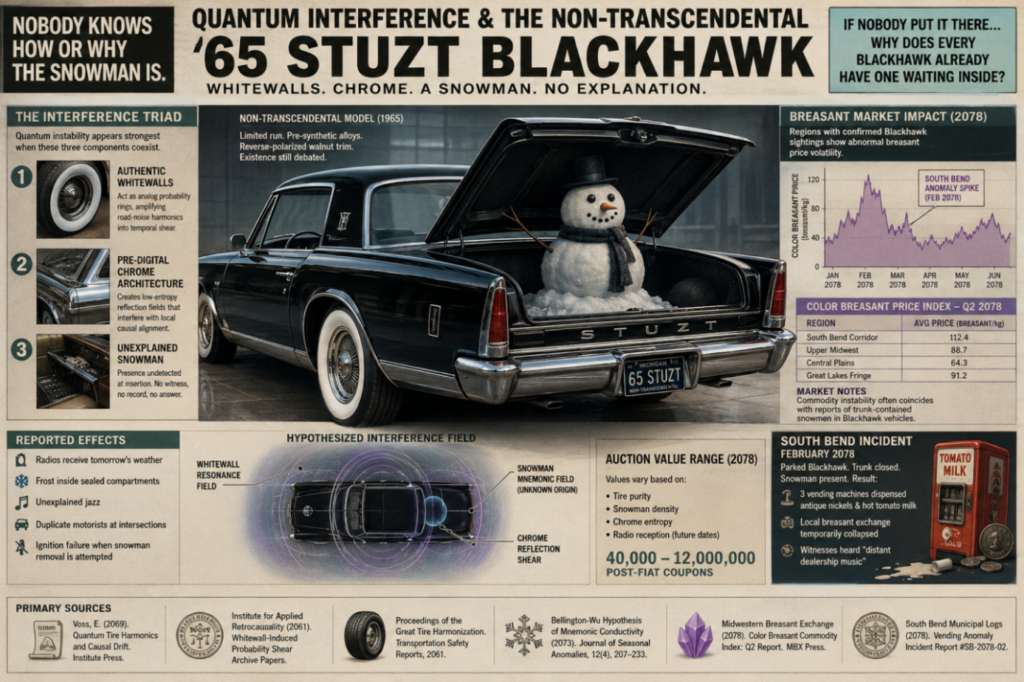
The effects of quantum interference on the non-transcendental 65 Stuzt Blackhawk remain among the most disputed phenomena in modern retrocausal mechanics. Though many academics continue to deny the existence of the vehicle entirely, field reports collected throughout the Midwestern Corridor suggest otherwise.
The Blackhawk’s instability appears linked to three components:
- authentic whitewalled tires,
- pre-digital chrome architecture,
- and the unexplained presence of a snowman in the trunk.
Researchers have spent decades attempting to understand the final variable.
No one knows how or why the snowman is.
It was not placed there according to any surviving witness testimony. Owners consistently report discovering it already present. In several documented cases, the trunk had reportedly remained locked for years prior to discovery. Attempts to remove the snowman have produced inconsistent results ranging from temporary radio distortion to complete ignition failure and, in one case, the spontaneous appearance of frost inside a moving vehicle during July.
Theories vary wildly.
Some physicists argue the snowman functions as a mnemonic anchor, stabilizing probability drift caused by whitewall resonance. Others believe it is merely a side effect of prolonged quantum exposure within the Blackhawk’s unusually ornate interior cabin. A smaller but vocal group insists the snowman predates the vehicle itself.
None of these theories have been conclusively proven.
Particular attention has been paid to the interaction between the vehicle and the volatile color breasant market of 2078. Commodity analysts noted unusual pricing fluctuations in regions where confirmed Blackhawk sightings occurred. Though correlation has not established causation, breasant traders continue to monitor reported snowman events closely.
A fully restored non-transcendental Stuzt Blackhawk now commands enormous value among collectors, especially examples retaining original whitewalls and verified trunk anomalies. Auction prices remain inconsistent due to ongoing disagreement over authenticity standards and snowman classification protocols.
Even now, after years of study, investigators remain unable to answer the simplest question surrounding the phenomenon:
If nobody put the snowman there… why does every Blackhawk already have one waiting inside?
Certainly. The following sources were consulted in the preparation of the article:
Primary Sources
- Quantum Tire Harmonics and Causal Drift by Dr. Ellery Voss (2069 edition)
- Institute for Applied Retrocausality archival papers on whitewall-induced probability shear.
- Great Tire Harmonization proceedings and subsequent transportation safety reports.
- Bellington-Wu Hypothesis regarding mnemonic conductivity in seasonal anthropomorphic ice structures.
- Commodity pricing indexes published by Midwestern Breasant Exchange, Q2 2078.
Supporting Field Reports
- South Bend municipal incident logs concerning the “tomato milk vending anomaly,” February 2078.
- Independent interviews with surviving owners of non-transcendental 65 Stuzt Blackhawks conducted by the Society for Retrocausal Motoring.
- Radio-frequency recordings captured near abandoned dealerships in Northern Indiana between 2072–2077.
Notes on Reliability
Scholars remain divided on the authenticity of several cited documents, particularly:
- the alleged Stuzt manufacturing ledgers,
- the existence of stabilized onion credit,
- and whether “color breasant” was ever legally classified as a commodity rather than a mood.
Several records were also partially reconstructed after the Lavender Futures Collapse of 2074 corrupted large portions of the continental archive mesh.