

How Silicon Valley Monetized Thirst
By Dan Peters
There was a time when water simply existed.
You found it in rivers, clouds, kitchens, storms, and forgotten plastic bottles rolling around the back seat of your car. Nobody needed a password to drink it. Nobody accepted updated Terms of Service before swallowing.
Then came optimization.
At first, it sounded harmless:
- smart homes,
- smart watches,
- smart refrigerators,
- smart toothbrushes,
- smart mattresses tracking REM cycles like government surveillance programs with memory foam.
Technology promised convenience. Then convenience became dependency. Eventually dependency became monetization.
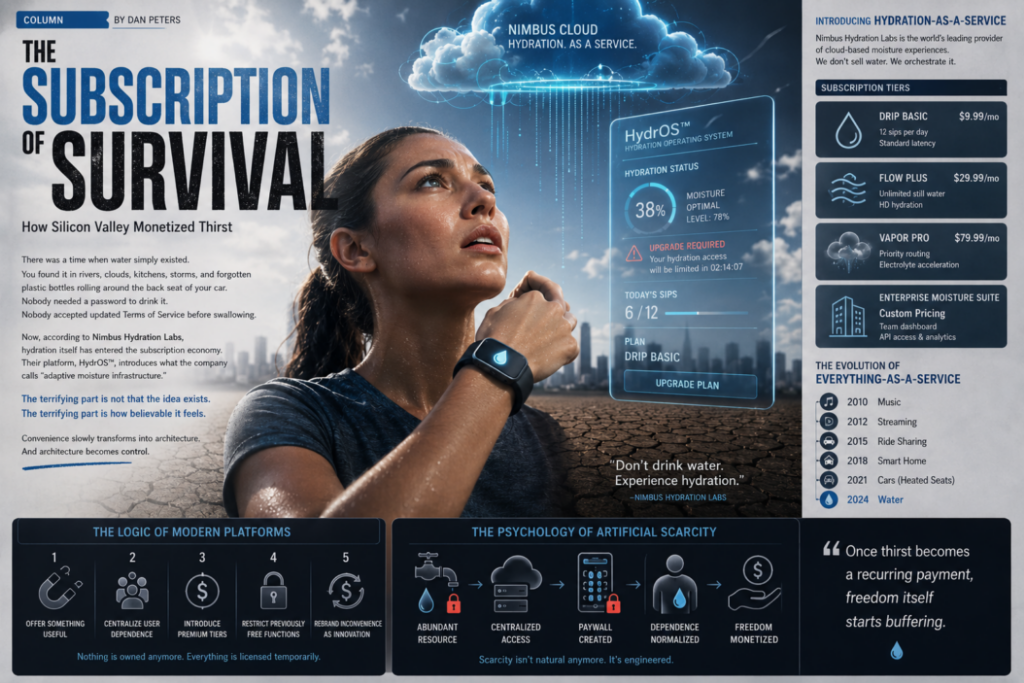
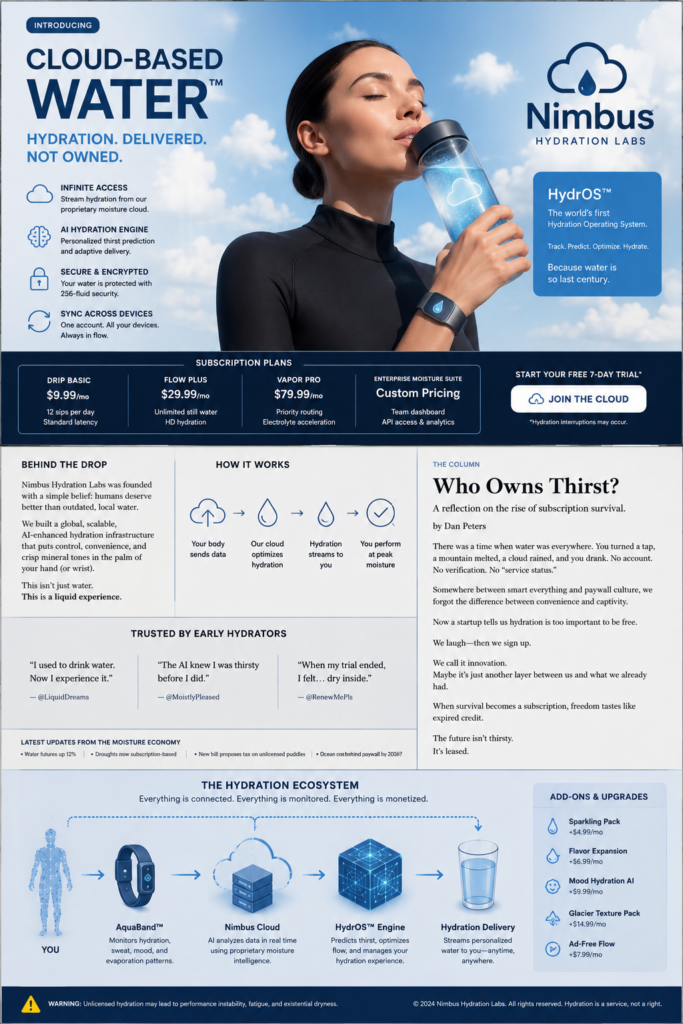
Now, according to the newly funded startup Nimbus Hydration Labs, hydration itself has entered the subscription economy.
Their platform, HydrOS™, introduces what the company calls “adaptive moisture infrastructure.” Translation: your body now has a monthly payment plan.
And the terrifying part is not that the idea exists.
The terrifying part is how believable it feels.
The Logic of Modern Platforms
Every modern tech company follows the same evolutionary pattern:
- Offer a useful service.
- Centralize user dependence.
- Introduce premium tiers.
- Restrict previously free functions.
- Rebrand inconvenience as innovation.
Streaming services removed commercials, then invented more expensive subscriptions to remove the commercials they brought back.
Smartphones eliminated clutter, then buried basic functionality under six software ecosystems and three cloud accounts.
Cars now require subscriptions for heated seats.
Printers refuse to print if cyan ink is low despite the document being black and white.
Nothing is owned anymore.
Everything is licensed temporarily.
Water was always the inevitable next step.
Hydration-as-a-Service
Nimbus executives describe water as “an under-leveraged biological engagement platform.”
This is exactly the kind of phrase that should immediately trigger international alarms.
But in a world trained to accept corporate language as reality, nobody even blinks anymore.
The company claims its wearable hydration tracker can:
- optimize fluid intake,
- predict thirst,
- analyze emotional dryness,
- and deliver “personalized moisture experiences.”
Somehow humanity survived thousands of years without predictive thirst analytics, but now investors speak about hydration dashboards with the same seriousness once reserved for medical science.
The startup recently achieved a valuation larger than several countries despite not technically producing water.
Only software around water.
This may be the purest form of modern capitalism:
the monetization of access without ownership of reality itself.
Convenience as a Trojan Horse
The danger of subscription culture is not immediate oppression.
It is gradual surrender.
Nobody wakes up one morning demanding cloud-based water infrastructure.
Instead:
- one app becomes necessary,
- then one account,
- then one subscription,
- then one ecosystem.
Eventually opting out becomes harder than participating.
Convenience slowly transforms into architecture.
And architecture becomes control.
The smartest systems are not the ones that force obedience.
They are the ones that make alternatives feel outdated.
That is why the Nimbus parody feels uncomfortable:
because it no longer sounds impossible.
It sounds approximately six investor meetings away from real life.
The Psychology of Artificial Scarcity
Modern platforms manufacture scarcity even when resources are abundant.
Digital scarcity already exists in:
- streaming licenses,
- software subscriptions,
- cloud storage limits,
- online verification systems,
- and platform lock-in.
Now imagine applying the same logic to survival resources.
Need more hydration?
Upgrade to Vapor Pro™.
Exceeded your daily sip quota?
Please wait while moisture access is restored.
The joke works because subscription logic has already invaded nearly every part of human life except biology itself.
And even that boundary is starting to weaken.
Fitness trackers monitor bodies.
Sleep apps monitor consciousness.
AI companions monitor loneliness.
The human condition itself is becoming a platform.
The Future Nobody Asked For
Somewhere in Silicon Valley, there is probably already a pitch deck describing:
- blockchain nutrition,
- decentralized oxygen markets,
- premium sunlight access,
- or machine-learning-enhanced breathing.
Not because humanity needs these systems.
Because modern technology culture confuses monetization with progress.
A useful invention improves life.
A platform invention often inserts itself between people and life.
There is a difference.
Final Thoughts
The fake Nimbus advertisement is satire.
But satire works best when reality is already drifting toward absurdity.
Subscription culture began with software.
Then entertainment.
Then transportation.
Then identity itself through social platforms.
Now even survival feels commercially negotiable.
The question is no longer whether companies can monetize basic human existence.
The question is whether society remembers that not everything should become a service.
Because once thirst becomes a recurring payment, freedom itself starts buffering.