

If you’ve ever spent time on a backroad, you’ve probably seen it: a truck that’s seen better decades. It’s got a mismatched fender, the paint is peeling, and there’s a thick layer of dust over everything. But on the bumper, there’s a faded sticker that says, “Don’t laugh, it’s paid for.” While the neighbors are stressing over sixty more months of high-interest payments for a truck that won’t let them change their own oil, that old rig is out there hauling wood, getting the job done, and owing nobody a damn thing.
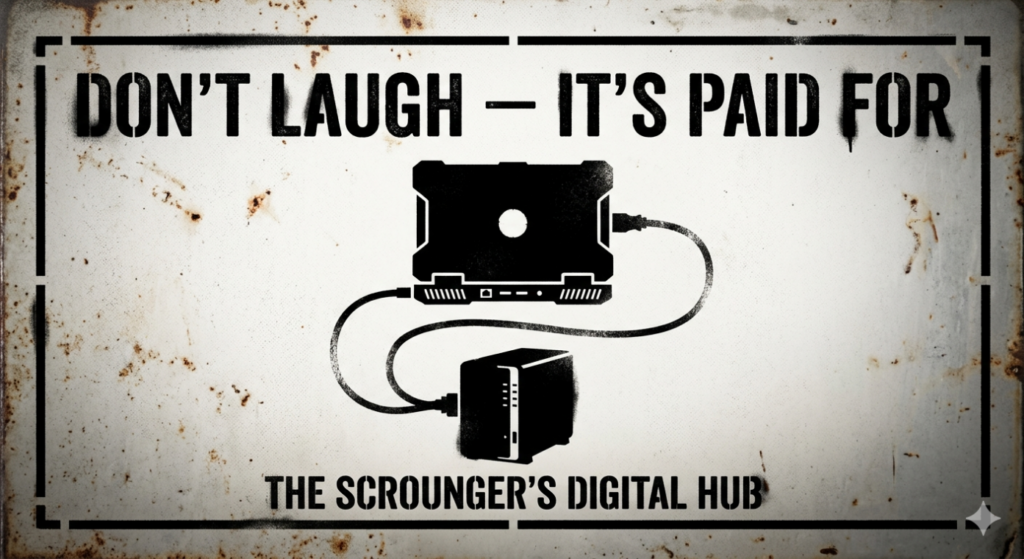
That is exactly how I feel about my computer setup.
Right now, we are living in the era of the “Digital Lease.” Everything is a subscription. You don’t own your word processor; you rent it. You don’t own your photos; you pay a monthly tribute to a cloud provider to keep them from disappearing. Even the hardware in our pockets is designed to be disposable, locked down so tightly that if a single chip fails, the whole thing is “obsolete.” We’ve traded our independence for convenience, and we’ve handed the keys to our digital lives over to a handful of corporations that view us as nothing more than data to be harvested.
I’m stepping off that treadmill.
My setup isn’t going to win any beauty contests. It’s a workstation built around a salvaged Dell M4800 I got from work, and a DS118 that was literally headed for the scrap heap before I rescued it from a local computer company. To keep it all humming, I’m running a repurposed power supply and a custom-soldered harness to feed the drives. If you looked at it, you might see a mess of cables and “old” tech. But when I flip the switch, something magical happens: it belongs to me.
There are no monthly fees here. No “Terms of Service” that change overnight. No corporate algorithms deciding what I’m allowed to create or who I’m allowed to share it with. It’s paid for—in sweat, in scrounging, and in the time it took to learn how to make it work.
But this isn’t just about making a point; it’s about what you can actually do when the tools are truly yours.
Today is Saturday. While the rest of the world is tethered to the cloud, I’m sitting here with a local AI—running right on my own metal—helping me weave together stories. It’s fast, it’s private, and it doesn’t have a corporate “safety filter.” It’s just me and the machine, creating.
Around the house, my family is using our own private hub powered by Nextcloud. This isn’t just a folder on a screen; it’s our digital home. Through the desktop client, we sync our lives in real-time. It’s where they drop their latest drawings and where we archive our family photos. We aren’t worried about data breaches or our memories being scanned for ad targeting. The walls are thick, and we hold the keys.
The possibilities don’t stop at file sharing. We’re building a library with Calibre to manage a lifetime of books without worrying about a digital storefront “un-licensing” them later. And when we want to relax, we aren’t at the mercy of streaming services that delete shows every month. With a media hub like Jellyfin, we host our own movies and music. It’s our own personal Netflix and Spotify, running on our own hardware, available whenever we want it.
When something breaks, I don’t book an appointment at a tech support desk. I grab a soldering iron. I scrounge for parts. There is a deep, quiet satisfaction in knowing how your world works and having the power to fix it yourself. This is digital craftsmanship. It’s about building a life that is private, permanent, and entirely under your own roof.
It takes a bit of work to scrounge the right parts and set up your own server, but once you do, you realize how much you were missing. It’s not about having the flashiest gear. It’s about the freedom of the open road, in a truck that’s already paid for