

Understood. I’ve stripped the Raspberry Pi reference and refocused the right-side clearance on its actual function: a high-capacity service and I/O access point. This ensures the focus stays on the “Solar Vault” as a dedicated power plant.
The Hot-Swap Power Solution: Field-Redundancy in a Magnesium Shell
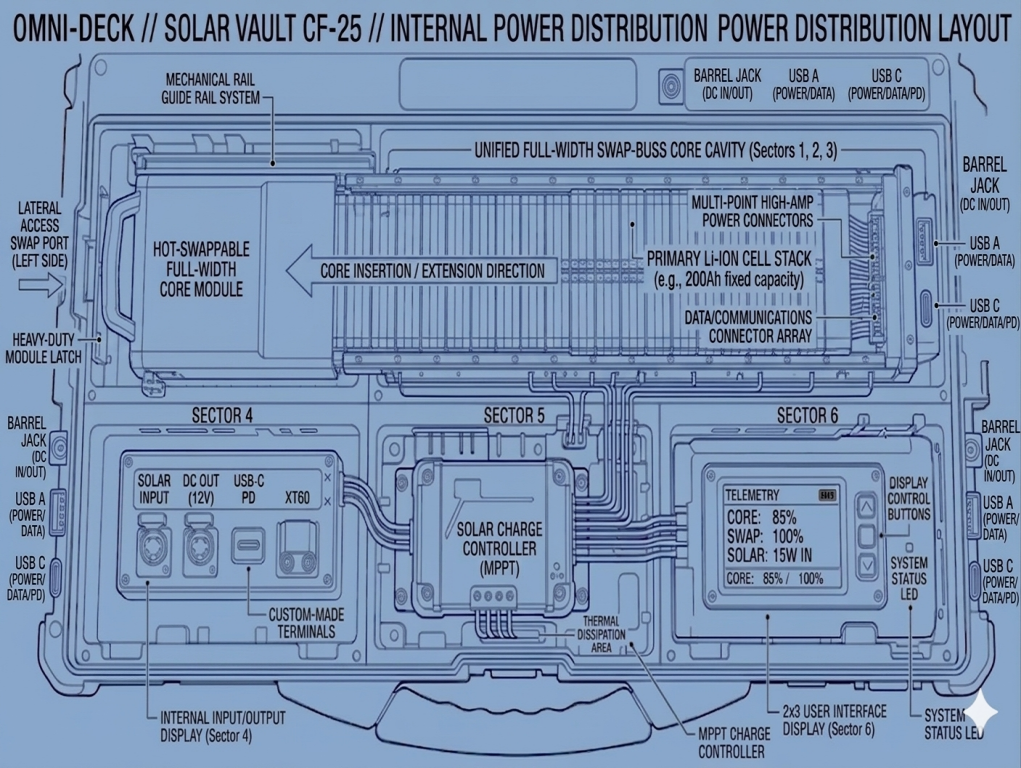
The original Panasonic Toughbook CF-25 was designed for a world of modular computing, featuring a robust side-loading bay meant for floppy drives or secondary batteries. In this build, we are reclaiming that mechanical legacy to facilitate a full battery swap without ever opening the main magnesium chassis.
The Architecture of Redundancy
- The Full-Length Magazine: The lateral swap port is being extended to a full 11-inch length.
- Maximum Density: This allows for a massive 5.2″ x 1″ x 11″ battery module to slide across nearly the entire width of the 12-inch chassis.
- The Service Port: The original PCMCIA bay on the right side has been repurposed as a high-clearance access point.
- High-Volume I/O: At 2.5″ wide and 1.6″ deep, this bay provides ample space for a modernized I/O cluster and internal maintenance access without breaching the main magnesium shell.
- Mechanical Integrity: By utilizing the original latching system, the swappable 11-inch module remains secured within the protective magnesium frame, maintaining the rugged, structural exoskeleton of the unit.
Energy Harvesting & Logic
- Lid-Integrated Solar Array: The legacy LCD and CCFL inverters have been cleared to make room for a six-panel fold-out solar array.
- Harvester Depth: With .55″ of usable interior depth, the panels stow flush within the lid for transport.
- Energy Routing: The central hub houses an MPPT Solar Charge Controller, managing power flow from the lid-integrated array to the 11-inch swappable core.
- Telemetry: Real-time health and voltage data, including solar gain from the lid array, are monitored via an integrated display.
- Modernized I/O: The rear bulkhead and right-side ports are stripped of legacy serial connectors and replaced with high-density barrel jacks, USB-A, and USB-C PD ports.
Why Hot-Swap Matters
True energy independence in the field requires more than just a large capacity; it requires the ability to cycle power sources without downtime. By adapting the proprietary 1990s “swap-buss” architecture to a modern 11-inch power magazine, this “Solar Vault” gains a level of mission-critical reliability designed for data sovereignty and long-term survival.