

Most people recognize May Day as a spring holiday, but its origins are rooted in a violent struggle for the most basic unit of autonomy: time.
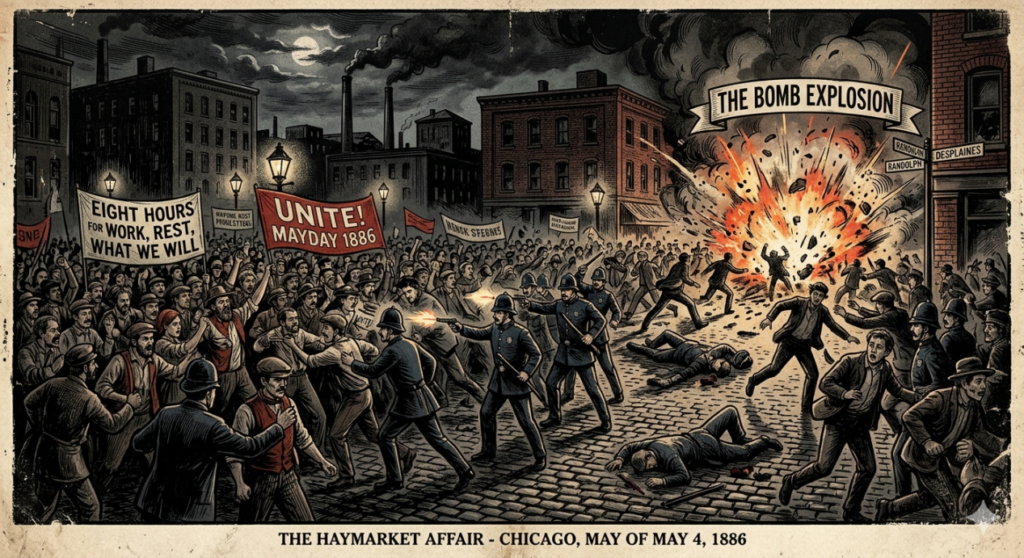
In 1886, American workers typically labored 10 to 16 hours a day in unregulated industrial centers like Chicago. On May 1, 1886, hundreds of thousands of workers went on strike to demand an eight-hour workday. They weren’t just asking for less work; they were demanding the right to a life outside of the machine.
The Conflict
The situation turned deadly on May 3, when police fired into a crowd of strikers at the McCormick Harvesting Machine Company. In response, a protest was called for the following evening, May 4, at Haymarket Square.
The rally was peaceful until police arrived to disperse the crowd. An unknown person threw a dynamite bomb, and the ensuing chaos killed seven officers and several civilians. In the aftermath, eight labor leaders—the “Chicago Eight”—were tried for murder. Despite no evidence linking them to the bomb, four were hanged. They became martyrs for the idea that a worker is a human being, not a disposable part of an engine.
The Shift: From Time to Tools
The struggle at Haymarket was about who controls the terms of your life. In 1886, that control was held by the factory owners who owned the physical gates you walked through. If you didn’t like the terms, you were locked out.
Today, the “gates” have changed. We don’t stand in front of a factory; we log into a platform. But the vulnerability is the same:
- Dependency as a Trap: The Haymarket strikers realized that if one entity owns the tools, the housing, and the hours, the worker is never truly free. In the digital age, if a corporation owns the data, the software licenses, and the hosting environment, you are operating on a “digital company town” model.
- The Struggle for Agency: The fight for an 8-hour day was about carving out a space that the boss couldn’t touch. Today, Self-Hosting and Data Sovereignty are the modern versions of that “untouchable space.” It’s about building a shop where no one else can change the locks or “update” your tools into uselessness.
- Mechanical Integrity: The Haymarket era established that the person operating the machine has rights. In 2026, that right is the Right to Repair. If you aren’t allowed to see how your tools work—or fix them when they break—you are back in the 1880s, entirely dependent on the person who sold them to you.
May Day is a reminder that independence is never given; it’s built. The strikers at Haymarket fought for the right to own their time. Today, the fight is for the right to own the tools we use to fill it.