

If you are looking to push the boundaries of “small-batch” artisanal food to the absolute physical limit, the tardigrade (Phylum *Tardigrada*) represents the final frontier. Forget micro-greens; we are talking about **micro-proteins**.
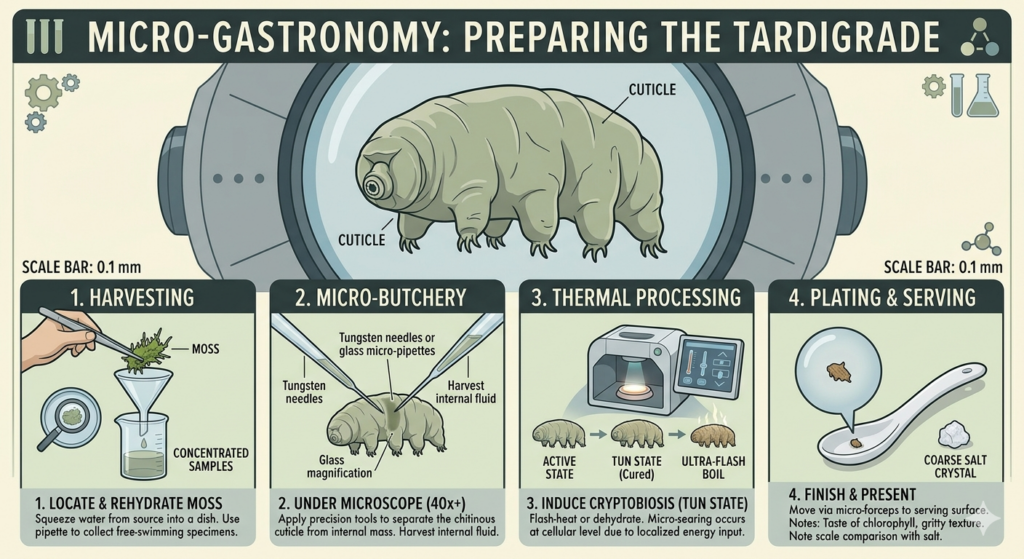
Because these organisms are less than 0.5 mm long, you must abandon the kitchen and move into the laboratory. Here is the technical breakdown for processing and “cooking” the world’s toughest microscopic organism.
—
I. The Harvest (Sourcing the Stock)
You don’t buy tardigrades by the pound; you “wildcraft” them.
1. **Locate:** Find high-quality, damp moss or lichen (the “terroir” matters here).
2. **Soak:** Place the moss in a funnel lined with a coffee filter over a beaker of distilled water.
3. **Filter:** After 24 hours, the tardigrades will have migrated into the water. Use a centrifuge to concentrate them into a “pellet” at the bottom of a test tube.
II. Micro-Butchery: The “Drawn” Preparation
At this scale, the “meat” is essentially a slurry of storage cells and a rudimentary digestive tract.
**The Scalpels:** Use etched tungsten needles controlled by a **micromanipulator**.
**The Incision:** Under 40x magnification, use a **longitudinal dorsal cut**. You are attempting to peel back the chitinous cuticle to expose the internal body cavity (the hemocoel).
**The Yield:** There are no “cuts” like brisket or loin. You are harvesting the entire internal mass, minus the tough outer skin.
http://googleusercontent.com/image_content/178
III. Culinary Techniques for Extremophiles
Conventional heat is your enemy. A stovetop flame will incinerate a tardigrade instantly. You must use **precision thermal induction**.
1. The Dehydration “Cure”
Before cooking, you must trigger the **Tun State**. By slowly reducing humidity, the tardigrade pulls in its legs and replaces its internal water with **trehalose** (a natural sugar).
* **Result:** You have effectively “candied” the tardigrade in its own biological sugars.
2. Ultrasonic Cavitation (The “Micro-Sear”)
To “cook” the proteins without losing the specimen to evaporation, use an ultrasonic bath. The high-frequency sound waves create microscopic bubbles that collapse and release intense localized heat, “poaching” the tardigrade from the inside out in a fraction of a second.
3. The “Leidenfrost” Flash-Fry
For a “crispy” finish, use a precision soldering iron set to $110^{\circ}C$. A nanosecond of contact will flash-steam the surface moisture, creating a microscopic version of a sear.
—
IV. Plating and Flavor Profile
Plating:** Use a single hair from a specialized “spotting brush” to move the finished specimen onto a polished silicon wafer.
The Garnish:** A single grain of fine salt is roughly the same size as the meal; use a crushed crystal for “seasoning.”
Palate Note:** Given their diet of moss and algae, a prepared tardigrade will taste predominantly of **chlorophyll and damp earth**, with a texture similar to a single, microscopic grain of sand that dissolves instantly.
> **Chef’s Note:** You would need to repeat this process approximately **2.5 million times** to fill a standard teaspoon. Efficiency is low; the “flex” is high.