

Introduction
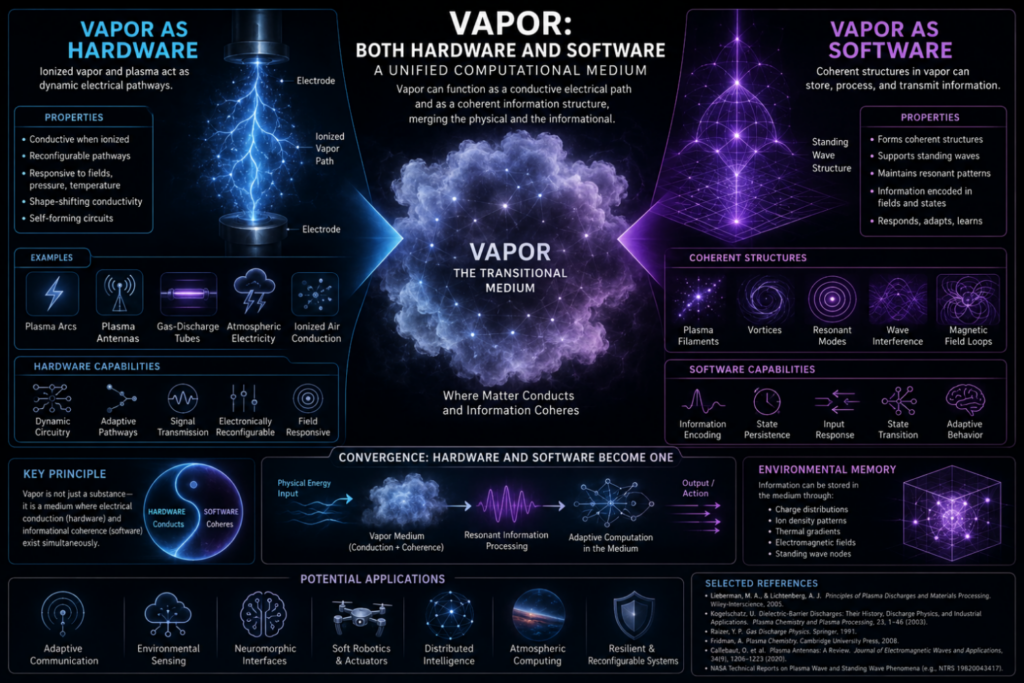
The concept of vapor as a computational medium challenges the traditional separation between hardware and software. Instead of viewing computation as something confined to solid-state electronics, this framework explores how ionized vapor, plasma states, standing waves, and coherent energetic structures may function simultaneously as conductive hardware pathways and information-bearing software systems.
Modern plasma research already demonstrates that ionized gases can conduct electromagnetic signals and dynamically reconfigure transmission properties. (ResearchGate)
This opens the possibility that vapor-like media may someday support adaptive computational architectures where physical structure and informational structure merge together.
Vapor as an Electrical Hardware Path
Conductive States in Vapor
Ionized vapor and plasma are electrically conductive. Research into gaseous plasma antennas shows that ionized gas can transmit and receive electromagnetic waves in ways similar to metallic conductors. (ResearchGate)
Unlike conventional metal circuitry, plasma conduction is dynamic and reconfigurable. Plasma antennas can alter:
- frequency,
- impedance,
- bandwidth,
- radiation patterns,
- and signal direction electronically rather than mechanically. (sciencedirect.com)
This means vapor-like conductive pathways can behave as temporary hardware structures rather than fixed permanent circuits.
Dynamic Circuitry
Research on reconfigurable plasma antennas demonstrates that conductive gaseous structures can be switched on and off or reshaped through changes in ionization and electromagnetic control. (SRS Journal)
In this sense, vapor hardware behaves more like an adaptive field than a rigid object.
Instead of etched copper traces:
- pathways emerge dynamically,
- conductivity changes over time,
- and geometry becomes responsive to environmental conditions.
This resembles biological systems more than classical electronics.
Vapor as Coherent Software Structure
Information Without Solid-State Form
Software is fundamentally organized information.
Normally that information is stabilized within semiconductor memory and processors. However, physical systems can also sustain organized informational states through resonance, oscillation, and field coherence.
Research in plasma physics shows that standing waves and resonant plasma structures can form stable energetic patterns. (Cambridge University Press & Assessment)
These coherent states suggest that information-like organization may exist directly within energetic media.
Standing Waves as Computational Structures
Standing waves are particularly important because they create persistent spatial patterns.
In plasma systems, standing waves can:
- stabilize energy distributions,
- create repeating nodal structures,
- maintain phase relationships,
- and preserve coherent field geometries over time. (NASA Technical Reports Server)
A standing-wave structure behaves similarly to memory because:
- it persists,
- it responds to external input,
- and it influences subsequent system behavior.
This creates a theoretical bridge between physical resonance and software-like state organization.
The Convergence of Hardware and Software
Matter and Logic Becoming Unified
Traditional computing separates:
- hardware as physical machinery,
- and software as abstract instructions.
The vapor-computation model weakens this distinction.
If the conductive medium itself reorganizes dynamically according to informational patterns, then:
- hardware becomes adaptive,
- software becomes physical,
- and computation becomes environmental.
Research into plasma-based transmission systems already demonstrates partially reconfigurable conductive architectures. (ResearchGate)
The next conceptual step is imagining systems where:
- resonant structures encode logic,
- energetic stability stores information,
- and field geometry performs computation.
Resonance-Based Computation
Computing Through Frequency Interaction
Conventional digital systems compute through binary switching.
A vapor-based system could instead process information through:
- phase synchronization,
- wave interference,
- resonance locking,
- oscillatory stability,
- and electromagnetic coupling.
Standing plasma waves and resonant plasma interactions are already active areas of physical research. (Cambridge University Press & Assessment)
In this framework:
- logic becomes resonance,
- memory becomes persistent field structure,
- and processing becomes dynamic energetic interaction.
The “software” is no longer code stored in silicon but coherent organization maintained inside the medium itself.
Environmental Memory
Memory Stored in Fields
Theoretical vapor computation also introduces the concept of environmental memory.
Instead of storing information inside transistor arrays, information may exist temporarily through:
- charge topology,
- ion density distributions,
- standing-wave nodes,
- thermal gradients,
- or electromagnetic persistence.
Research on plasma interfaces and plasma-wave behavior supports the existence of stable field interactions capable of maintaining organized state relationships. (arXiv)
This transforms memory into a spatial and energetic phenomenon rather than a purely material one.
Philosophical Implications
Computation as a Property of Matter
The broader implication is that computation may not require conventional machines.
Instead:
- organized matter may compute naturally,
- fields may process information intrinsically,
- and dynamic environments may behave algorithmically.
Vapor becomes symbolic of a transitional computational state:
neither purely physical hardware nor purely abstract software.
It exists between the two.
Conclusion
The idea that vapor can simultaneously function as a conductive hardware pathway and a coherent software structure proposes a radically different vision of computation.
Scientific research already confirms that ionized gases and plasma systems can:
- conduct electricity,
- transmit electromagnetic signals,
- form standing-wave structures,
- and dynamically reconfigure themselves. (ResearchGate)
The speculative extension of these principles suggests that future computational systems may emerge directly from energetic organization itself.
Rather than computation occurring inside matter, matter may become computation.