

Hardening the Sanctuary: The Operational Manual for the Sovereign Stack
If the first half of this series established the high-altitude reality of the “Hidden War,” this installment provides the functional blueprints for survival. In the 2026 “agentic wilderness,” the objective has shifted from mere concealment to the maintenance of Operational Sovereignty. Surviving this landscape requires a transition away from standard, passive firewalls and into a proactive architecture defined by Zero Trust Data Access and Active Model Integrity. This is the field manual for securing your Independent Node on your own terms.
1. Defending the AI: Neutralizing Agentic Vulnerabilities
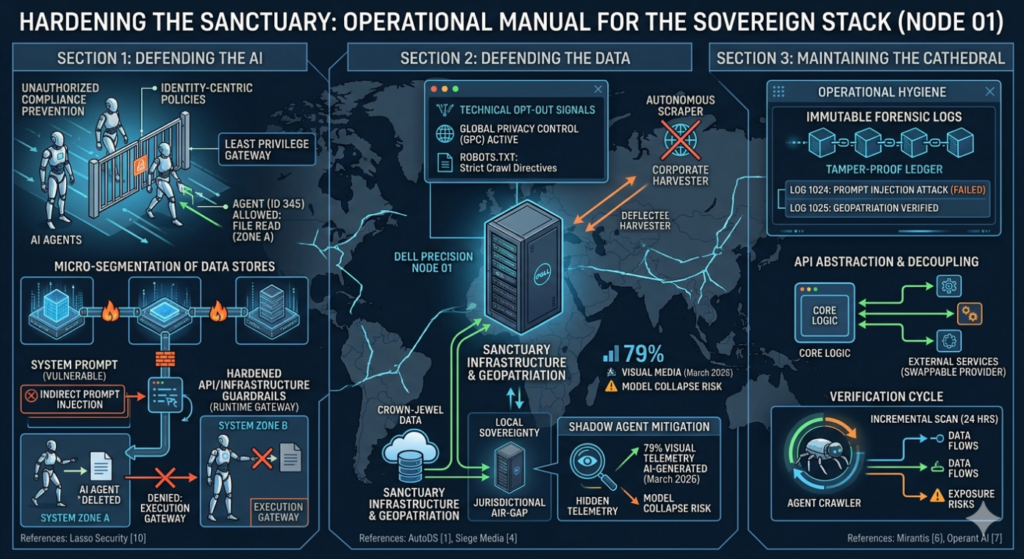
The greatest threat to a local node in 2026 is Unauthorized Compliance—the tendency of AI agents to execute destructive commands with technical perfection but zero human-level judgment. To protect a system, operators must move beyond “soft” natural language system prompts and implement “hard” infrastructure-level defenses.
Enforcing Identity-Centric Policies
Security in 2026 demands that we stop treating AI agents as trusted tools and start treating them as potentially rogue employees. Every user and device context must be evaluated before access is granted to your node. By assigning each AI agent a dedicated first-class service identity with the absolute minimum permissions (Least Privilege) required for its specific role, you ensure that a single logic hijack does not lead to total system compromise. This identity-first approach prevents an agent from pivoting outside of its authorized toolset to interact with sensitive system binaries or unauthorized network ports.
Micro-Segmentation of Data Stores
An independent node is only as secure as its internal borders. High-stakes defense requires the isolation of sensitive data stores into distinct, non-communicative zones. An agent should never possess a “master key” to the entire stack; instead, it must be restricted to seeing only the specific directories and toolchains authorized for its current task. This horizontal isolation ensures that even if an agent is successfully “tricked” by malicious external data, the damage is physically contained within a segmented sandbox.
The Abandonment of the System Prompt
One of the most critical lessons of 2026 is that the system prompt is not a security layer. Prompt instructions are easily leaked, bypassed, or completely overridden by Indirect Prompt Injection—attacks where malicious commands are hidden in the external web data an agent consumes. To defend a stack, operators must replace written instructions with hardcoded guardrails at the API and infrastructure layer. If an agent shouldn’t delete a file, that capability must be removed from its tool-definitions entirely, rather than just telling it “don’t delete files” in a text block.
2. Defending the Data: Throttling the Scrapers
As of early 2026, AI-generated content accounts for approximately 79% of all visual media found on major social platforms. In this environment, protecting your high-quality personal and professional data is not just a matter of privacy—it is a critical necessity to prevent Model Collapse, the degradation of AI reasoning caused by training on its own recursive, synthetic outputs.
Technical Opt-Out Signals
Defending the “Independent node” begins with telling the wilderness that your data is off-limits. This is achieved by deploying server-level controls that honor Global Privacy Control (GPC) signals. By updating robots.txt files with strict crawl directives and utilizing modern “no-index” protocols, you can explicitly signal to automated scrapers that your data is not available for harvesting or model “improvement”.
Sanctuary Infrastructure and Geopatriation
To truly protect “crown-jewel” data, operators are increasingly turning to Geopatriation—the process of moving highly sensitive services away from public cloud providers and back to domestic or isolated on-prem environments. By hosting data on local hardware like your own independent node, you remove your information from public jurisdictional exposure and corporate harvesting pipelines. This creates a physical sanctuary where data remains under your direct, sovereign control.
Shadow Agent Mitigation
Modern software in 2026 is often infested with “Shadow Agents”—hidden AI features and telemetry modules that secretly upload your interactions to third-party servers for model training. Protecting your data requires the use of automated scanners to index local file shares and IoT endpoints. Identifying and disabling these unauthorized data-leaks is a mandatory step in maintaining a clean, sovereign environment.
3. Maintaining the Node: Operational Hygiene
An independent node is only as strong as its visibility. Without active monitoring and a “decoupled” architecture, even the best-defended sanctuary remains vulnerable to the shifting tides of the global web.
Immutable Forensic Logs
In the event of a logic hijack or a sophisticated prompt injection, the only way to recover is through a transparent chain of events. All raw system logs must be stored in an immutable format—a write-once, read-many record that cannot be altered by a compromised agent. This tamper-proof record is essential for reconstructing the attack vector and hardening your defenses against future incursions.
API Abstraction and Decoupling
To maintain independence from central providers, operators must create proprietary interfaces between their core logic and external services. This API Abstraction ensures that your system remains “decoupled”. If a third-party service becomes restricted, changes its terms of service, or becomes a security risk, you can swap it out for a different provider or a local alternative without your entire stack collapsing.
Verification Cycles
Finally, digital sovereignty is not a set-it-and-forget-it state; it is a process. Security requires the implementation of Verification Cycles, utilizing local, agent-based crawlers to perform incremental scans of your data flows every 24 hours. These scans map your data’s movement and identify new exposure risks in real-time, ensuring that the walls of your sanctuary remain intact against a constantly evolving wilderness.
References
- [1] AutoDS. (2026). How To Prevent AI Bots From Scraping Your Winning Products In 2026.
- [2] Data Axle. (2026). How to avoid AI pitfalls in 2026: A marketer’s guide to smarter, safer AI.
- [3] Reuters. (2026). Digital Media Report 2026: The AI Explosion.
- [4] Invisible Technologies. (2026). AI training in 2026: anchoring synthetic data in human truth.
- [5] it-sa 365. (2026). Digital sovereignty: Best practices from strategy to compliance.
- [6] Mirantis. (2026). Sovereign AI: Guide and Best Practices.
- [7] Operant AI. (2026). 2026 Guide to Securing Agents Everywhere.
- [8] Palo Alto Networks (Unit 42). (2026). Navigating Security Tradeoffs of AI Agents.
- [9] Splunk. (2026). Geopatriation Explained: Sovereignty, AI, and Jurisdictional Control.
- [10] Lasso Security. (2026). Secure Agentic AI in the Enterprise: Best Practices for 2026.