

The Fractured Frontier: Navigating the 2026 Digital Battlefield
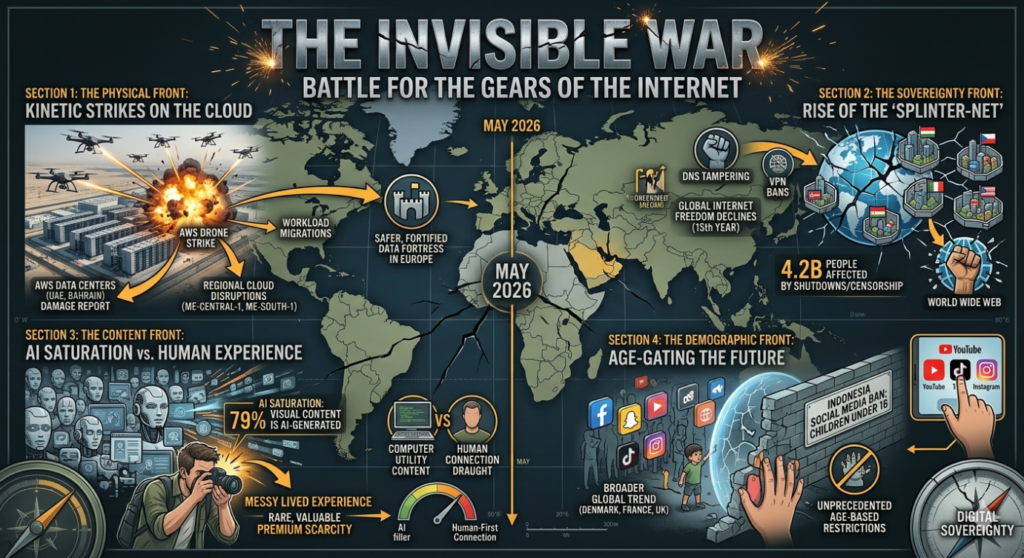
The internet in 2026 is no longer a collaborative library; it is a high-stakes wilderness where digital sovereignty is the only viable defense. As we move toward Agentic AI—systems capable of making autonomous decisions—the “hidden war” shifts from protecting data to protecting the integrity of logic itself. This conflict is no longer a metaphorical struggle; it has evolved into a kinetic, legal, and biological fight that has redefined the digital “wilderness” we navigate daily.
The Physical Front: Kinetic Strikes on the Cloud
The first major shift occurred in the physical realm, where the “cloud”—long treated as an abstract, untouchable layer of reality—became a literal target of kinetic warfare. On March 3, 2026, Amazon Web Services (AWS) confirmed that drone strikes tied to regional conflicts in the Middle East directly hit two data centers in the UAE and damaged a third in Bahrain. This marked a definitive transition from cyber-attacks to physical strikes against the nodes of the internet, forcing massive workload migrations to safer geographic territories as AWS warned that restoring these regions would take several months.
The Sovereignty Front: Rise of the “Splinter-Net”
Simultaneously, the dream of a unified web is dissolving into a collection of “national intranets” as governments prioritize total digital sovereignty over global connectivity. Global internet freedom has declined for the 15th consecutive year, with authorities in at least 57 out of 72 countries assessed having arrested or imprisoned individuals for online expression. Last year, more than half the world’s population—over 4.2 billion people—was affected by government-mandated internet shutdowns or systemic censorship. Nations such as Iran, China, Russia, and Myanmar have moved toward aggressive “whitelisting,” where only government-approved sites are accessible, effectively disconnecting their populations from the global web. To maintain this “Balkanization,” many of these environments have tightened restrictions, criminalizing the tools used to bypass these digital borders.
The Content Front: AI Saturation vs. Lived Experience
This infrastructure war is matched by a content war that is reshaping online reality through sheer volume. The “Dead Internet Theory”—the idea that the web is primarily bots talking to bots—has become a functional reality in 2026. By March of this year, AI-generated images accounted for a staggering 79% of all visual content posted on major platforms like Instagram and TikTok. As machine-produced data outpaces human output, users are experiencing a “Connection Drought,” where 97% of content marketers now plan to use AI to support their efforts. In an infinite surplus of polished machine-made media, the value of lived-experience content has skyrocketed because it provides the one thing a generative model cannot: proof that a human was actually there.
The Demographic Front: Age-Gating the Future
Finally, the struggle has reached a demographic front as governments increasingly treat the internet as a public health hazard for minors. On March 28, 2026, Indonesia officially banned children under 16 from having accounts on high-risk social media platforms, including YouTube, TikTok, and Instagram. This mirrors a broader global trend where nearly a quarter of new internet restrictions in the last year specifically targeted social media access for younger users, coinciding with legislative efforts in countries like Denmark, France, and the UK. From the physical destruction of data centers to the regulatory “pruning” of the web for the next generation, this conflict is a fight for the very gears that keep our digital world turning.
References
- [1] Clark, A. (2026, March 3). Drone Strikes Damage Amazon Data Centers in the UAE and Bahrain. Insurance Journal.
- [2] Freedom House. (2025). Freedom on the Net 2025: An Uncertain Future for the Global Internet.
- [3] Reuters. (2026). Digital Media Report 2026: The AI Explosion.
- [4] Siege Media. (2026, March 4). 51 AI Writing Statistics To Know in 2026.
- [5] GO-Globe. (2026, April 23). Internet Censorship 2026: 4.2B Affected and Key Stats.
- [6] Developing Telecoms (2026, May). Regional Cloud Disruptions and Infrastructure Security.
- [7] JURIST News (2026, March) / The Guardian (2026, March 6). Indonesia to ban social media for children under 16.