
There is a specific, quiet magic that happens about 24 hours after you’ve successfully migrated your digital life to your own hardware. It’s the “Clean Slate” effect. For the first time in years, you aren’t waking up to a notification that your storage is 90% full, or a “Terms of Service” update that feels like a legal shakedown.
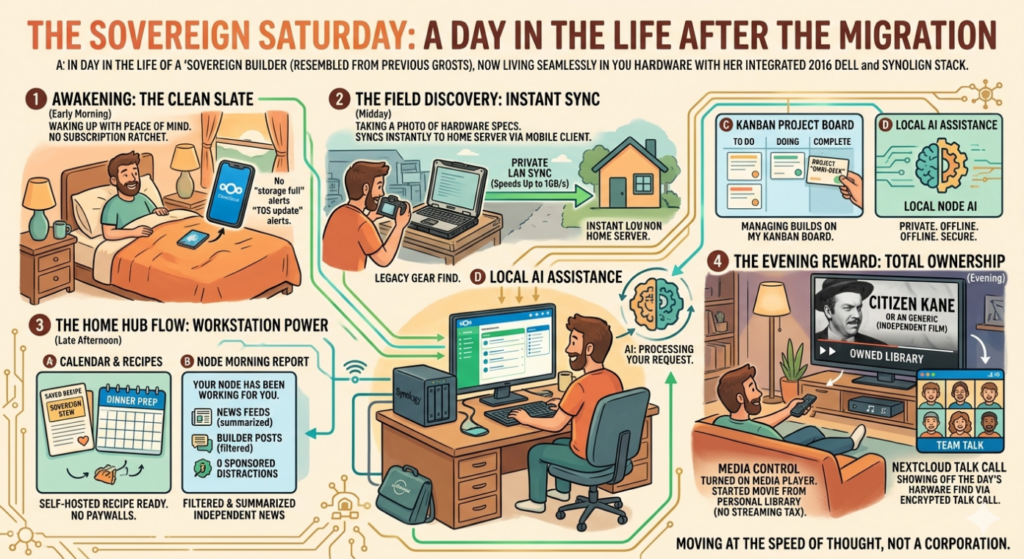
The first few hours are usually spent in a bit of a daze. You move that first batch of “hostage” data—the family photos, the business spreadsheets, the project blueprints—from the corporate cloud over to your local drive. You watch the sync bar move at the actual speed of your home network, and you realize you’ve just stopped paying rent on your own memories. You aren’t just “backing up” your files; you are bringing them home.
But the real shift isn’t technical; it’s psychological. You stop looking at your computer as a portal to a corporation and start seeing it as a tool that belongs to you. There’s no bloatware popping up in the corner, no “suggested news” based on your search history, and no hidden processes eating your RAM just to report your habits back to a headquarters you’ll never visit. The system is quiet. The system is yours.
The Integrated Flow: A Day in the Life
Picture this: You’re out at a local surplus warehouse, and you spot a piece of gear that belongs in the stack. You snap a photo of the serial number and the specs. By the time you’ve walked back to your truck, that photo has already synced—privately and instantly—to your home server via your Nextcloud mobile client. There was no “uploading to the cloud” lag; it just moved from one pocket of your life to another.
When you walk through your front door, you sit down at your Linux workstation. You don’t have to “import” anything or wait for a cloud refresh. The photo is just there, waiting in your project folder. You open your self-hosted Calendar to see what’s on the menu for dinner—a recipe you saved months ago that hasn’t disappeared because a website went behind a paywall.
While you prep, you check the “morning report” from your node. While you were out, your system was working for you: it gathered the specific news and RSS feeds you actually care about, filtered out the noise, and summarized the latest posts from the independent builders you follow. There are no “sponsored” distractions—just the information you asked for.
You glance at your Kanban board to see which project cards were moved to “Complete” today, then you give a quick prompt to your local Node AI. Without hitting the public internet, the AI acknowledges your request, turns on your media player, and starts a movie from your own personal library—not a streaming service that might remove it next month.
As the music starts to fade in, you initiate a Nextcloud Talk call with the team to show off the new hardware find. You’re moving at the speed of thought, supported by a system that doesn’t ask for a subscription, doesn’t watch your every move, and doesn’t answer to anyone but you. This is what it feels like when the hardware finally works for the human. This is a Sovereign Saturday.