

This is a deep dive into the global shift. We are witnessing the first real cracks in the “Big Data” empire. In 2026, the wind has shifted: between skyrocketing energy costs, the environmental toll of massive data centers, and new laws protecting humans from being replaced by algorithms, the Sovereign Stack is no longer just a hobby—it is a survival strategy.
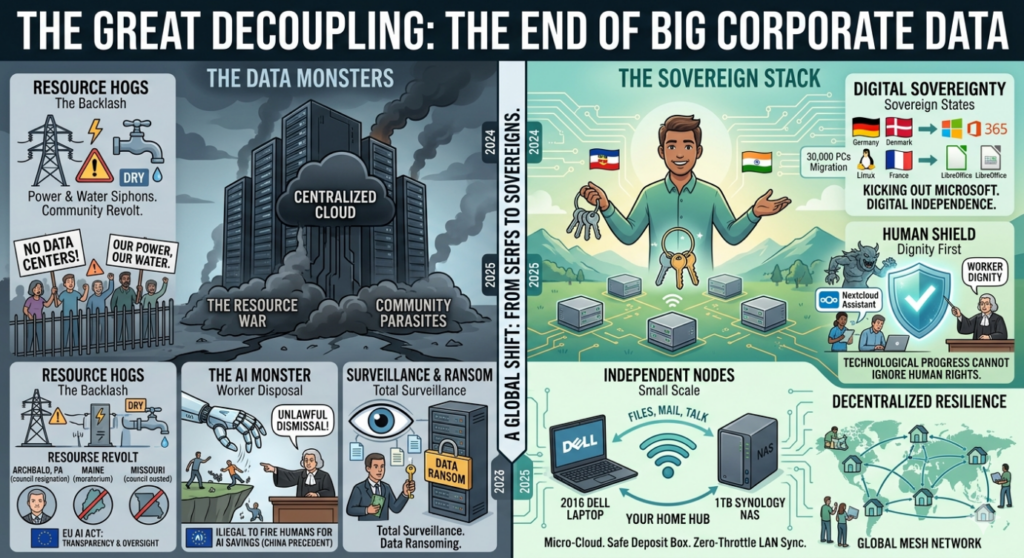
The Great Decoupling: The End of Big Corporate Data
The age of digital centralization is dying. For twenty years, we lived under the “Data Monsters”—massive corporations that convinced us our data was safer in their hands than our own. We traded our privacy for “free” services, not realizing the bill would eventually come due in the form of total surveillance, data ransoming, and the erosion of local resources.
As we move through 2026, the exodus has begun. From entire nations switching to open-source software to local communities physically blocking the construction of data centers, the “Corporate Normal” is being rejected in favor of the Independent Node.
1. The Sovereign State: Nations Jumping Ship
The most visible blow to corporate dominance is coming from governments that have realized that relying on a foreign corporation for their infrastructure is a national security risk. They are moving toward “Digital Sovereignty.”
- Germany (Schleswig-Holstein): This state has become a global vanguard. As of late 2025, their migration to LibreOffice reached 80% completion, with a goal to fully replace Microsoft Windows and Office across 30,000 government computers by 2026 [1.1, 1.2]. They expect to save over €15 million annually in licensing costs—public money that stays in the local economy rather than flowing to Redmond [1.1].
- Denmark: In mid-2025, the Danish Ministry of Digital Affairs committed to a major policy change, replacing Microsoft Office 365 with LibreOffice to reduce dependence on foreign technology providers [2.1, 2.2].
- France: Long a champion of open source, France saw Linux desktop market share cross the 5% threshold in early 2026, a symbolic victory for digital independence in the region [6.1].
- India: Leading the charge in the major economies, India recorded a staggering 16.2% Linux adoption rate, as the nation builds its own independent tech ecosystem to avoid vendor lock-in [6.1].
2. The Resource War: Data Centers as Community Parasites
While the “Cloud” sounds airy and light, its physical reality is heavy, hot, and hungry. Data centers are increasingly viewed as community parasites that siphon local resources while providing little in return.
- Energy and Water Siphons: A single large AI data center can consume as much power as twice the amount used by an entire state like Utah [3.1]. In terms of water, they require millions of gallons daily for cooling, often in regions already facing scarcity.
- The Community Backlash: In Archbald, Pennsylvania, a proposal for six data centers led to such a fierce community revolt that four out of seven town council members resigned in April 2026 [3.1]. Similar stories have played out in Missouri, where a town ousted its entire city council after they approved a $6 billion data center project [3.1].
- The “Shadow Grid”: To sidestep strained public grids, some developers are now building private natural gas “Shadow Grid” power plants, further alienating local populations who see their environmental goals sacrificed for corporate server space [3.1].
3. The Human Shield: Protecting Workers from the AI Monster
The “replacement era” is meeting its first real legal walls. In 2026, courts and legislatures are starting to mandate that technological progress cannot come at the cost of human dignity.
- China’s Landmark Precedent: In April and May 2026, the Hangzhou Intermediate People’s Court ruled that it is illegal to fire employees simply to replace them with AI to save money [4.1, 4.2]. The court ruled in favor of a quality assurance supervisor who was fired after refusing a demotion and massive pay cut when his tasks were automated. The court stated that a company’s choice to adopt AI is a business risk that cannot be forced onto the employee [4.1].
- The EU AI Act: As of August 2, 2026, the EU’s AI Act enters full force for “high-risk” systems [5.1]. This includes AI used in employment—recruitment, performance evaluation, and termination. Companies must now prove human oversight and transparency; they can no longer hide behind a “black box” algorithm to justify firing someone [5.1].
- Italy and Beyond: Italy passed a law in early 2026 requiring strong worker rights and union consultation regarding AI in the workplace, ensuring that “efficiency” does not bypass human rights [5.1].
4. Rise of the Independent Node
While the giants are being regulated and resisted, a quiet revolution is happening in basements and home offices. Independent Nodes—like a salvaged 2016 Dell or a Synology NAS—are forming a global, decentralized mesh.
These small-scale systems are the antithesis of the corporate data center. They don’t require massive cooling plants or millions of gallons of water. They use the hardware we already own and the electricity we already pay for. By 2026, the Linux desktop market share globally has climbed to 4.7%, fueled by people refusing to “orphan” perfectly good hardware just because Windows 11 says it’s too old [6.1].
The Bottom Line
The end of big corporate data isn’t happening with a bang; it’s happening with a thousand small clicks. It happens every time a government signs an open-source contract, every time a community blocks a resource-hogging data center, and every time a person like you plugs in an old laptop and says, “This is my server. This is my data. And you can’t have it.”
The landscape of 2026 is clear: The giants are struggling to hold onto their monopoly, while the individuals are reclaiming their power. The Sovereign Stack isn’t just the future of computing—it’s the future of freedom.
Sources Cited:
- [1.1] It’s FOSS, “Schleswig-Holstein to Save €15 Million by Kicking Out Microsoft,” Dec 2025.
- [1.2] Licenseware, “From Microsoft to Open Source: German State Rewriting Rules,” Apr 2025.
- [2.1] Linux Journal, “Denmark’s Strategic Leap to LibreOffice,” Sep 2025.
- [2.2] Windows Forum, “Denmark Switches to Linux for Digital Sovereignty,” Jun 2025.
- [3.1] Tom’s Hardware, “Town Council Resigns as Town Fights Back Against AI Data Centers,” Apr 2026.
- [4.1] WUSF, “Tech Worker in China Replaced by AI Wins Unlawful Dismissal Case,” May 2026.
- [4.2] Caixin Global, “Chinese Courts Rule Companies Cannot Fire Workers to Replace with AI,” Apr 2026.
- [5.1] DLA Piper, “The Digital AI Omnibus: High Risk AI Obligations Under EU AI Act,” Apr 2026.
- [6.1] Reddit/Market Reports, “Linux Adoption Rate by Country [2026 Status],” Feb 2026.