

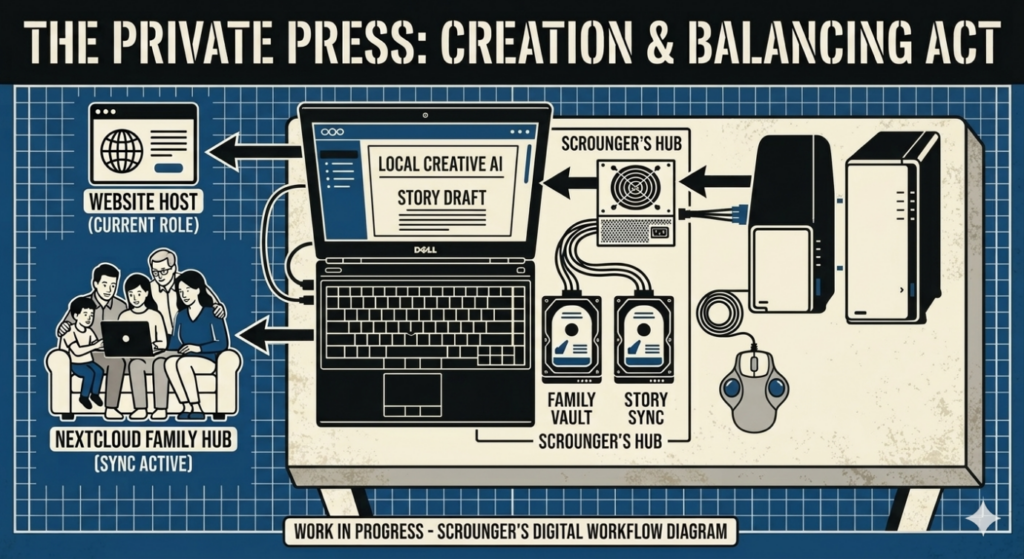
There’s a specific kind of quiet that comes with a Saturday morning project. In most homes, that quiet is constantly interrupted: a notification that your cloud storage is full, or a software update that moves every button you just learned to use. In this house, the only sound is the steady, rhythmic hum of the Dell M4800 doing the heavy lifting under the desk.
I spent years in the printing and manufacturing industries, managing high-volume departments. In those worlds, if you didn’t own the press, you didn’t own the work. Building this “Scrounger’s Hub” is my way of bringing that industrial independence into the digital age. It’s about owning the press.
Creation Without a Middleman
Right now, I have a local AI model spun up and working. It’s not sitting in a massive data center halfway across the world; it’s running right here, three feet away from me, on metal that I salvaged and configured myself.
The best part about running your own creative tools is the lack of corporate “guardrails.” When you use a public AI, you’re creating inside a padded room. If your story gets too gritty, the machine shuts you down or lectures you. When you run it locally, the only limit is your imagination. Whether I’m drafting a short story or brainstorming a hardware build, the machine doesn’t talk back. It just works. It’s a raw tool, like a hammer or a lathe, and it belongs to me.
The Balancing Act
Of course, running a “sovereign node” on ten-year-old hardware is a lesson in resource management. Currently, the M4800 is a one-machine army. It’s hosting this website, managing our Nextcloud hub, and keeping the Calibre library organized.
Because I’m asking it to be a creative workstation and a 24/7 server at the same time, I have to be smart. I can’t just throw every service at it—things like heavy media streaming will have to wait. The goal is to eventually scrounge a second machine to split the load: one to handle the public-facing website and another to act as the dedicated internal home server.
The Digital Paper Trail
Even with those constraints, the workflow we’ve built mirrors the permanence of a physical archive:
- The Family Vault: As soon as I save a file, it syncs to our private Nextcloud hub. This isn’t a mysterious folder in the sky; it’s a dedicated drive in the room. Through the desktop client, the whole family has a shared space to collaborate.
- The Library: When a piece is finished, it goes into our Calibre library. We are building a permanent digital bookshelf—a collection that can never be “un-licensed” or deleted by a remote provider.
The Freedom of the Workbench
At the end of the day, this setup isn’t a museum piece or a hobby for the sake of having a hobby. It is a functional creative studio. It’s a printing press. It’s a typewriter. By scrounging the hardware—like that DS118 destined for the scrap heap—and wiring it all together with a repurposed PSU, we’ve built a place where we can be productive on our own terms.
We aren’t just “users” or “consumers” anymore. By taking responsibility for the hardware and the software, we’ve become the curators, the editors, and the owners of our own digital lives. It takes a little more work than just clicking “Agree” on a corporate contract, but the view from the open road is a whole lot better when you own the truck.