

In the modern educational landscape, the “T” in STEM (Science, Technology, Engineering, and Mathematics) has largely been reduced to “Consumption.” Students are taught to use tools—Tableau for data, AWS for hosting, Google Workspace for collaboration—but they are rarely taught to own them. This shift from architectural understanding to end-user proficiency has created a “Black Box Generation.” Independent computing—the act of scrounging, self-hosting, and maintaining one’s own stack—represents the only viable pedagogical cure for this systemic deskilling.
1. The Engineering of the “Scrounge”: Thermodynamics and Material Science
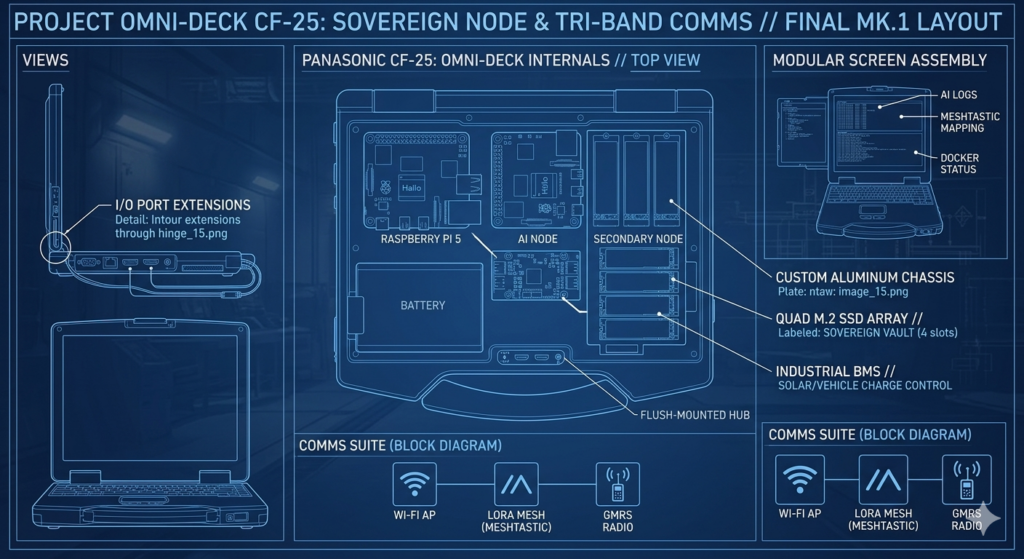
STEM education often begins in a vacuum—clean kits, new parts, and step-by-step manuals. Independent computing begins in the “e-waste” bin. When a student or hobbyist decides to rebuild a Dell Precision M4800 or a Panasonic Toughbook CF-25, they are engaging in a high-level audit of industrial engineering.
To repurpose a 2016 workstation as a 2026 “Source of Truth” node, one must understand thermal overhead. Why did the manufacturer use this specific alloy for the chassis? How does the heat-pipe array handle the TDP of a quad-core processor under a containerized load? In scrounging, the “E” in STEM moves from theoretical CAD drawings to the physical reality of magnesium fatigue and capacitor longevity. Fixing “chewed up” hardware is a lesson in material science that no software simulation can replicate.
2. Digital Sovereignty as Systems Architecture
The “S” in STEM—Science—relies on the reproducibility of results. In a cloud-dependent environment, the underlying infrastructure is opaque and subject to change without notice. When a student builds a “Sovereign Home Node” using Docker, Nextcloud, and local LLMs (like Ollama), they are not just “setting up a computer”; they are acting as a Systems Architect.
They must map the logic of a centralized power supply (like the 210W HP integration) to the power requirements of a multi-drive Synology stack. This requires a mathematical precision (the “M” in STEM) regarding voltage drops, amperage limits across a 24-pin harness, and the efficiency of DC-DC conversion. By building the “Spaghetti-Slayer” harness, the learner understands the literal flow of electrons that powers the digital abstraction.
3. Networking: The Physics of Connectivity
Modern education treats the “Cloud” as a magical ether. Independent computing treats it as a series of physical protocols. Integrating salvaged mesh networking or configuring local “Circles” in Nextcloud forces a confrontation with the OSI model.
When a student manages their own node, they learn the physics of GMRS, LoRa, and Wi-Fi propagation. They aren’t just clicking “Connect”; they are managing frequency interference and packet loss. This is the difference between a driver who knows how to use a GPS and a navigator who knows how to read the stars. One is a user; the other is a technologist.
4. The Ethics of Data Sovereignty
Perhaps the most overlooked aspect of STEM is the “Social” impact of Technology. Educational institutions have largely handed over student data to third-party providers. By teaching independent computing, we introduce an ethical layer to STEM: Who owns the output of the mind?
If a student’s research is stored on a server they built, powered by a harness they soldered, and protected by encryption they configured, they have achieved “Data Autonomy.” This instills a sense of responsibility and agency. It moves the student from being a “product” of the tech industry to being a “proprietor” of their own intellectual property.
5. Failure as a Pedagogical Tool
Standardized STEM education fears the “System Lockup” or the “Data Corruption.” In independent computing, these are the primary teachers. When a terminal command wipes a partition or a 12V rail shorts a harvested socket, the resulting troubleshooting is where the most profound learning occurs.
The student must use the Scientific Method:
- Observe the failure (the node is down).
- Hypothesize the cause (is it the PSU harness or the Docker config?).
- Test the variables.
- Iterate the solution.
This loop is the heartbeat of innovation. By stripping away the “safety nets” of corporate tech support, independent computing forces the learner to become the expert.
6. The “Chosen Family” Node: Collaborative STEM
Finally, projects like the “Polycule Nextcloud” demo illustrate how technology can be used to strengthen social bonds (the “Human” element of STEM). Building a collaborative environment for a “chosen family” or a local team isn’t just about permissions and hierarchies; it’s about building a digital commons. It teaches the administrator how to manage resources for a community—a skill essential for any future lead engineer or project manager.
Conclusion
The “marketing slickness” of modern technology is a mask for the loss of technical agency. To truly master STEM, one must be willing to look at a “chewed up” laptop and see a powerhouse. One must be willing to solder their own power distribution and host their own truth.
Independent computing isn’t just a hobby for “scroungers”; it is the most rigorous, honest, and vital form of education available in the 21st century. It is the transition from being a passenger in the digital age to being the pilot of one’s own destiny.