

Most people understand, at least vaguely, that technology companies collect information about them. They know websites use cookies. They know social media tracks clicks and likes. They know their phones contain GPS. What most people do not understand is the sheer scale of modern data collection, nor how deeply it has expanded into ordinary daily life.
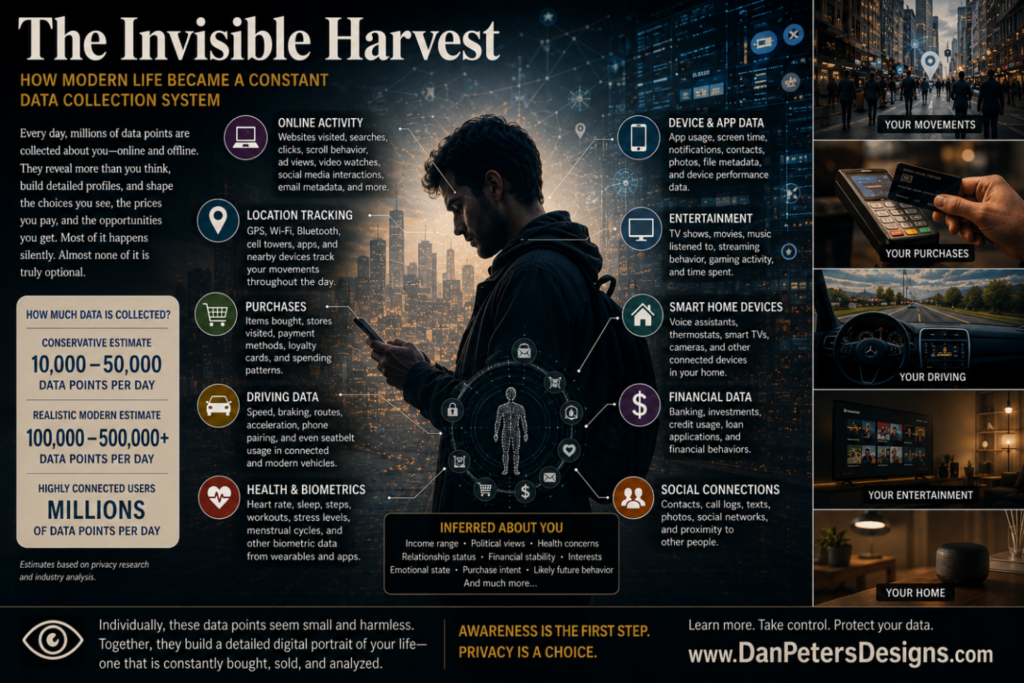
The average person now generates tens of thousands of measurable data points every single day. For heavily connected users, that number may rise into the hundreds of thousands or even millions. These data points do not come solely from internet browsing. They come from purchases, vehicles, phones, televisions, loyalty cards, smart watches, cameras, banking systems, and countless invisible exchanges between devices and networks operating silently in the background of modern life.
The result is a world in which ordinary behavior has become raw material for one of the largest industries ever created.
A modern webpage is no longer simply a webpage. It is often an ecosystem of trackers, analytics tools, advertising exchanges, behavioral monitors, and data collection systems operating simultaneously. A person visiting a single news article may unknowingly transmit information about their device, location, browser configuration, scrolling behavior, reading speed, mouse movement, interests, and purchasing likelihood within seconds. Even hesitation has become measurable. Pause too long over a photograph or advertisement, and systems may interpret interest. Scroll quickly past an article, and algorithms may register disengagement.
What makes this system particularly powerful is that data no longer exists in isolation. Information gathered in one place is often combined with information gathered elsewhere. A purchase at a grocery store may connect to location history from a smartphone. Streaming habits from a television may connect to advertising profiles built through social media activity. Vehicle telemetry may combine with insurance scoring systems. The individual fragments are assembled into behavioral models that attempt to predict not only who people are, but what they are likely to do next.
The smartphone became the centerpiece of this transformation. Rarely more than a few feet away from its owner, it functions as one of the most sophisticated consumer surveillance devices ever created. Phones continuously emit location data, Bluetooth signals, Wi-Fi scans, motion telemetry, and application analytics. Retailers use this information to measure foot traffic and shopping patterns. Advertising firms use it to estimate movement between locations. Data brokers use it to construct behavioral timelines detailed enough to identify where a person sleeps, works, shops, worships, or seeks medical treatment.
Modern vehicles have quietly joined the system as well. Connected cars increasingly collect information about speed, braking habits, acceleration, steering behavior, routes, maintenance status, and driver activity. Insurance companies now encourage drivers to install monitoring applications or telematics devices that track how aggressively they drive, when they travel, and whether they interact with their phones behind the wheel. Cars are no longer simply transportation. They are rolling sensor platforms.
Even the home has become part of the network. Smart televisions monitor viewing habits. Voice assistants process speech requests. Thermostats measure occupancy patterns. Doorbell cameras record visitors and movement. Fitness wearables gather biometric information around the clock. Individually, these systems appear convenient. Collectively, they create a continuously updating portrait of personal life more intimate than anything previous generations could have imagined.
Perhaps the most important reality of modern data collection is that the raw information itself is often not the final product. The true value lies in inference. Algorithms analyze patterns to estimate income, emotional vulnerability, political alignment, relationship stability, financial stress, addiction susceptibility, and future purchasing behavior. The goal is no longer merely to observe behavior. Increasingly, it is to predict and influence it.
This is why privacy has evolved from a niche technical concern into a broader cultural issue. The debate is no longer simply about advertising. Behavioral data now influences insurance pricing, financial services, recommendation systems, political messaging, and public opinion shaping. As predictive systems grow more sophisticated, the boundary between observation and manipulation becomes increasingly difficult to define.
Most people never consciously agreed to participate in systems of this scale. Privacy policies are rarely read, often deliberately opaque, and usually structured in ways that make meaningful consent questionable at best. Even individuals attempting to minimize tracking may still appear inside these systems through retail analytics, contact uploads, public surveillance infrastructure, or third-party data sharing agreements.
Modern life itself has become measurable.
That realization is beginning to reshape how people think about technology. Interest in encrypted communication, self-hosted services, open-source software, decentralized infrastructure, and local artificial intelligence systems continues to grow as more individuals recognize how deeply commercial surveillance has embedded itself into everyday existence.
The uncomfortable truth is becoming harder to ignore: if a system continuously records your habits, movements, purchases, interests, relationships, and routines, then your data is not merely a side effect of the product.
In many cases, your behavior is the product itself.